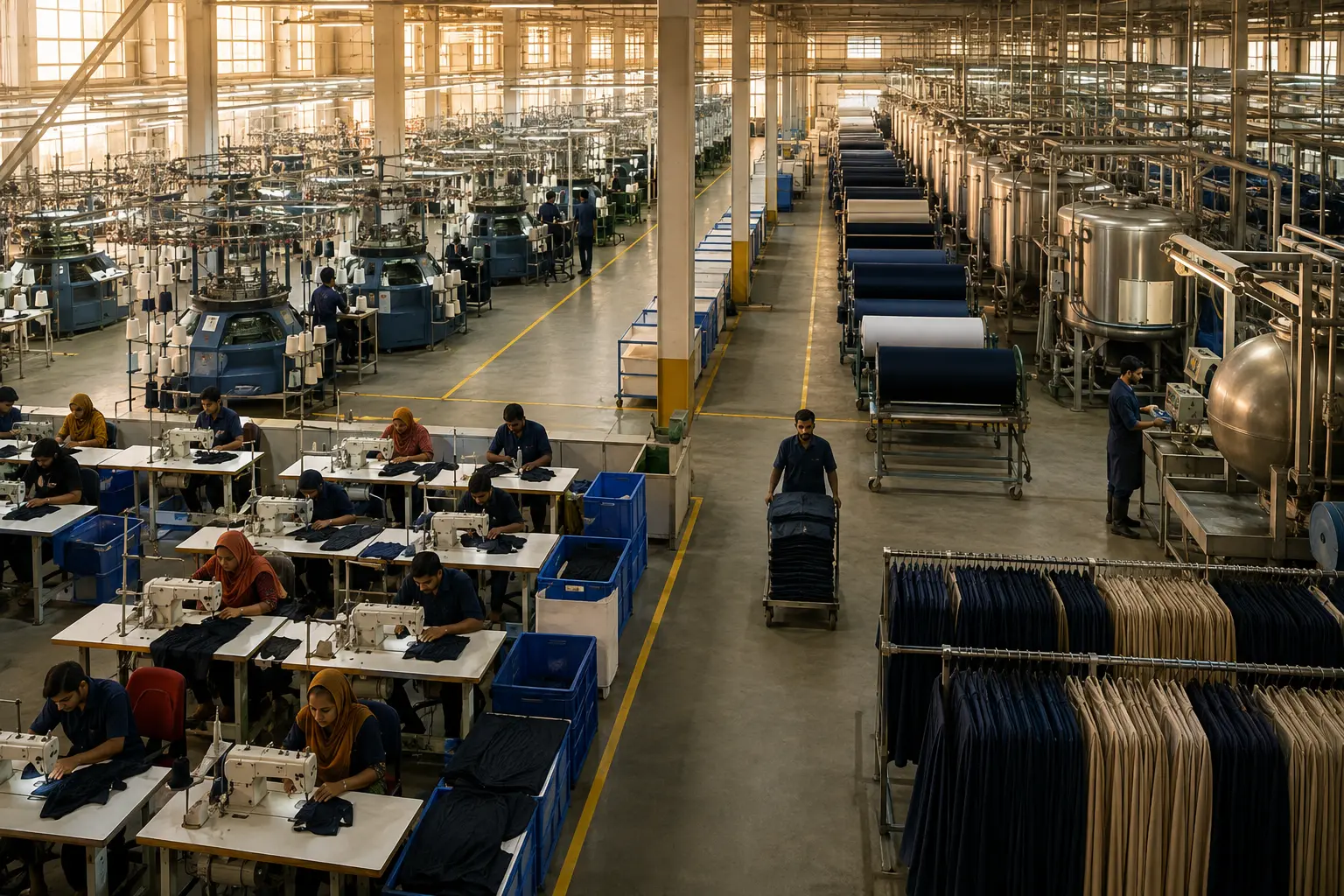
Private label manufacturing means a factory produces garments under your brand — your labels, your packaging, your specs — rather than the factory's own line. Bangladesh is one of the largest private label production bases in the world, but the terms buyers actually need clarity on before committing (MOQ, cost drivers, timeline, and what "full package" really includes) are often glossed over in favor of general industry pitch content. Here's the practical version.
Private Label vs. OEM vs. Full-Package — What's the Difference?
These terms get used loosely, but they matter for what you're actually agreeing to:
OEM (Original Equipment Manufacturer) — the factory manufactures to your exact specs and designs; you handle design, sourcing decisions, and often fabric sourcing yourself.
Private label — closer to a finished-product relationship: you select from existing styles or provide designs, and the factory handles most of production and sourcing, branding it as yours.
Full-package (FOB) — the most complete model: the factory sources fabric and trims, manages production end-to-end, and often handles export logistics, delivering a finished, ready-to-sell product.
Most buyers new to Bangladesh sourcing want full-package, since it removes the most operational complexity — but it's worth confirming explicitly which model a quote actually covers, since "private label" gets used to describe all three loosely across the industry.
What MOQ Actually Looks Like
Minimum order quantities vary significantly by factory tier and product complexity. As a general market reference: smaller and mid-sized factories often work with MOQs starting around 1,000 pieces per style/color, while larger, tier-one compliant factories frequently require 5,000+ units per style/color. [Insert Warptex's actual MOQ policy here — this needs to be a real, specific number to compete with published competitor figures.]
One detail buyers often miss: the garment MOQ isn't always the real constraint — fabric MOQ frequently is. A factory might accept your 1,000-piece order but require a much larger minimum on custom-dyed or specialty fabric to justify running that color through the mill. Always confirm both the garment MOQ and the fabric MOQ before signing a purchase agreement — surprises tend to live in that gap.
What Drives Cost
Private label pricing depends on several stacking factors, not just labor cost:
Garment complexity — a basic T-shirt and a structured outerwear piece involve entirely different labor, fabric, and finishing costs
Fabric choice — organic cotton, recycled content (GRS-certified), and technical fabrics all carry different base costs
Order volume — per-unit price drops meaningfully at higher volumes due to fixed setup costs being spread across more units
Finishing and trims — embroidery, printing, washing, and specialty trims each add cost and lead time
Certification requirements — GOTS, OEKO-TEX, or GRS-certified production may carry a premium over uncertified equivalents
[Insert Warptex's actual indicative pricing bands by product category — even a range like competitors publish gives buyers something concrete to evaluate against.]
Realistic Production Timeline
A typical private label order timeline runs roughly: sample development and approval, followed by bulk fabric sourcing, then production, then quality inspection and finishing, then shipping. Total time from confirmed order to shipped goods commonly spans [insert Warptex's actual typical timeline — e.g., "X-Y weeks depending on order complexity and season"]. Worth knowing in advance: Bangladesh's monsoon season (roughly June through September) can disrupt inland transport and fabric finishing schedules, and Q3 tends to be a peak production season industry-wide — booking early in a busy quarter avoids both lead-time stretch and tighter MOQ enforcement as factories prioritize larger existing clients.
What "Full Package" Should Actually Include
If a quote is described as full-package, confirm it explicitly covers:
Fabric and trim sourcing
Sample development and revisions through to approval
Production and in-line quality monitoring
Pre-shipment inspection against agreed AQL standards
Export documentation and shipping coordination
A quote that's vague on any of these points usually means that piece is handled elsewhere, at extra cost or by a third party you haven't vetted.
Questions to Ask Before You Commit
What's the MOQ for both the garment and the specific fabric I need — not just the general minimum you quote by default?
What certifications does your facility currently hold, and can I see current, unexpired documentation?
What AQL standard do you inspect finished goods against?
Who handles export documentation and customs clearance — you, or do I need a separate freight forwarder?
What's your realistic timeline for my specific order type and season, not just your fastest-case scenario?
Where Warptex Fits
Warptex operates full-package private label production across [insert Warptex's actual product categories — knit, woven, sweater, etc.] with in-house fabric sourcing, production, and QA/QC, backed by [certifications — GOTS, OEKO-TEX, GRS, BSCI, Sedex]. [Get a quote →] [See our production capabilities →]