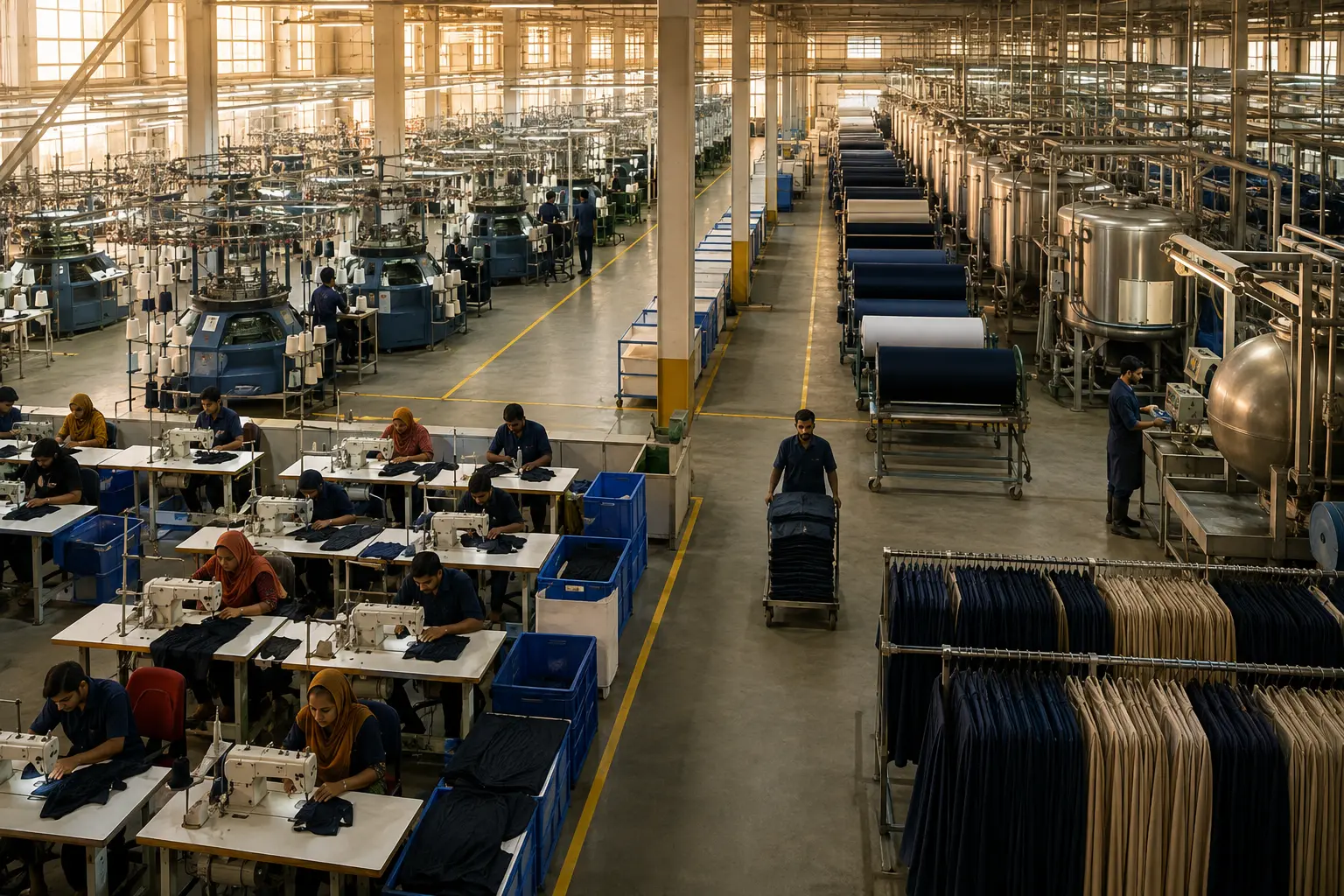
Bangladesh has quietly become the world's second-largest garment exporter, shipping over $39 billion in apparel annually. Here's what's driving that growth, how the industry is tackling its sustainability problem, and what's coming next as trade advantages start to shift.
Apparel Industry in Bangladesh: 2026 Overview & Outlook
H&M, Zara, Primark, Gap, Target — nearly every major apparel brand in the world sources from Bangladesh. Decades after the sector's first factories opened in Dhaka, Bangladesh has become the world's second-largest garment exporter after China, trailing only in scale but leading in growth momentum.
How Big Is Bangladesh's Apparel Industry?
The Ready-Made Garments (RMG) sector is the backbone of the national economy. Garment exports reached $39.35 billion in fiscal year 2024-25, an 8.84% increase year-on-year, and the industry now accounts for over 80% of the country's total exports. Roughly 4 million workers, more than half of them women, are employed across an estimated 5,000+ factories nationwide — making the sector one of the largest sources of formal employment for women in South Asia.
Why Global Brands Choose Bangladesh
Several structural advantages keep international buyers coming back:
Cost-effective labor — competitive wages relative to other major sourcing hubs
Duty-free market access — preferential trade terms with the EU, Canada, Japan, and others
Mature industrial infrastructure — specialized export zones and modern factories built specifically for large-scale apparel production
Deep, experienced workforce — decades of institutional garment-making expertise
Improved compliance standards — post-Rana Plaza reforms have driven significant gains in workplace safety and labor rights monitoring
Scale and delivery reliability — a large population means factories rarely face labor shortages, helping protect production timelines
Sustainability: From Liability to Leadership
Fashion is one of the world's most polluting industries, and Bangladesh has taken that criticism seriously. The country is now home to more than 190 LEED-certified green garment factories — including several ranked among the highest-scoring green factories globally — certified by the U.S. Green Building Council. Manufacturers are increasingly formalizing sustainability reporting, reducing water usage, and investing in energy-efficient production as brand partners demand verifiable, auditable environmental practices rather than one-off pledges.
Where Does Bangladesh Export To?
The United States remains the single largest destination for Bangladeshi apparel, followed closely by the European Union as a bloc, with the UK, Germany, France, Italy, Spain, Canada, Japan, and Australia rounding out the top markets. This diversified buyer base has helped the industry stay resilient through demand shocks in any single region.
What's Next for the Industry?
As Bangladesh prepares for graduation from Least Developed Country (LDC) status, the sector faces a harder decade ahead: duty benefits will gradually erode, and competition from Vietnam and other emerging hubs is intensifying. The industry's next phase of growth depends less on low-cost scale and more on:
Higher-value synthetic and technical fabrics
Verified, data-backed sustainability — not just certifications on paper
Faster product development and digital production tracking
Continued investment in compliance, quality assurance, and worker welfare
Where Warptex Fits In
At Warptex Bangladesh Limited, this is exactly where our production runs, compliance processes, and QA/QC systems are built to compete — combining the scale advantages of Bangladesh's manufacturing base with the traceability and reliability global brands now expect. [Learn more about our compliance standards →] [See how our production process works →]