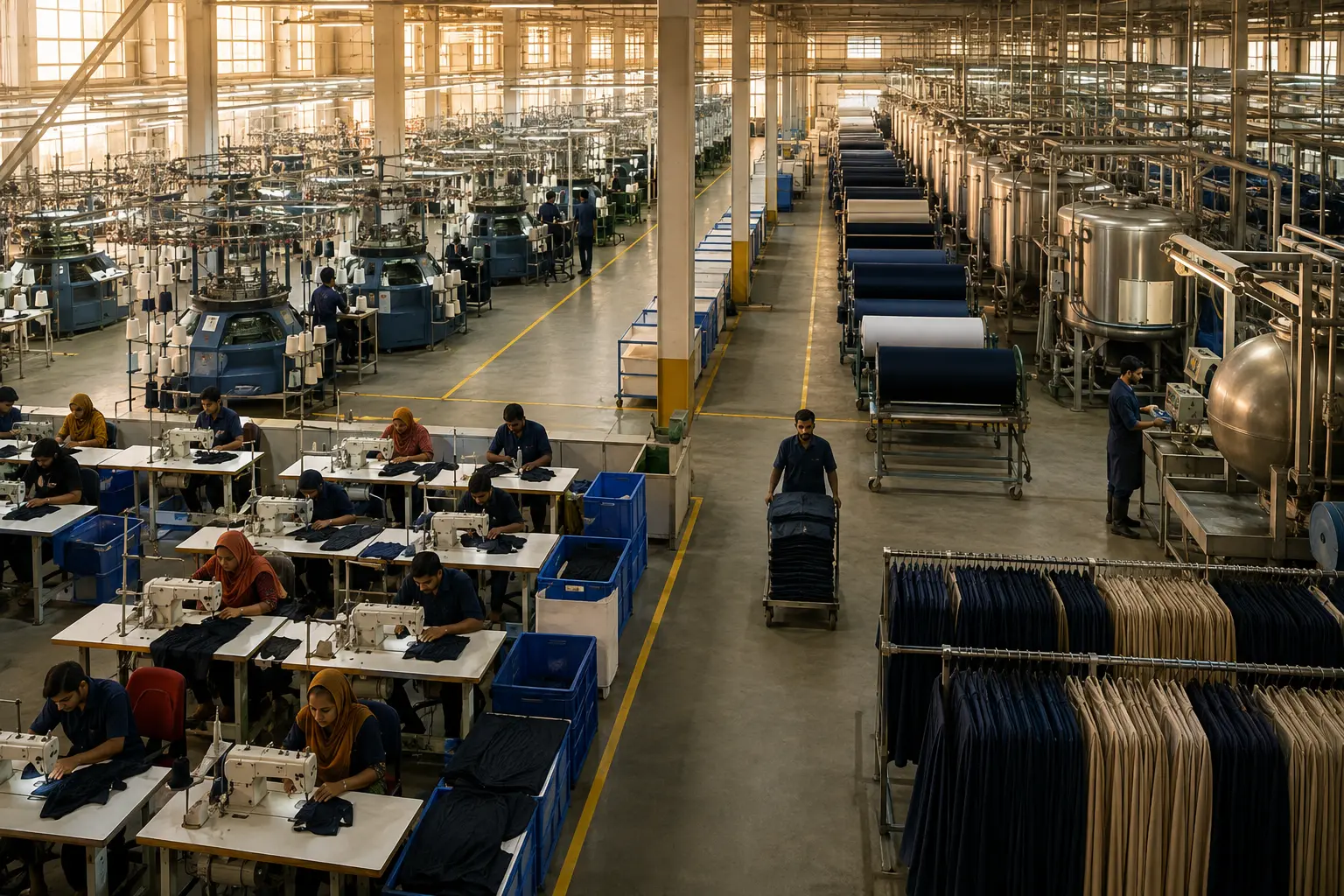
For most of the past two decades, comparing Bangladesh and China as sourcing destinations was a story about scale: China simply produced far more. That gap is still real — China holds roughly 27% of global apparel export share versus Bangladesh's approximately 7% — but 2026 has been the year the sourcing conversation between the two countries genuinely shifted, and buyers weighing where to place orders should understand why.
Bangladesh Overtook China in the US Market — But the Full Story Matters
Early 2026 data from the US Office of Textiles and Apparel showed Bangladesh climbing past China to become the second-largest apparel exporter to the United States. It's a real milestone, but the honest read is more nuanced than "Bangladesh won": Chinese apparel shipments to the US fell sharply, driven by tariff pressure and broader trade tensions, while Bangladesh's own exports also declined — just by a smaller margin. Industry voices in Bangladesh have been careful not to oversell this shift, noting that the underlying trend still reflects a fragile global demand environment rather than a clean competitive victory.
What's Actually Driving Buyers Away From China
The bigger structural story isn't one country's ranking — it's a broader "de-risking" trend. A significant majority of surveyed US fashion companies report plans to keep reducing their sourcing exposure to China over the next two years, and that shift predates and outlasts any single tariff announcement. Rising Chinese labor and operating costs, geopolitical trade tension, and a deliberate industrial pivot in China toward higher-tech, higher-value manufacturing sectors have all pushed labor-intensive garment production toward alternative markets — Bangladesh chief among them.
Where Bangladesh Genuinely Competes
Labor cost — Bangladesh's manufacturing wage base remains structurally lower than China's, a gap that isn't closing anytime soon.
Duty treatment (for now) — Bangladesh has been the only major garment-producing country with full duty-free, quota-free EU market access, a real cost advantage over China's standard tariff treatment. This changes as LDC graduation phases in from late 2026 onward, but the transition period preserves much of this advantage into 2029.
Vertical scale in cotton and knitwear — Bangladesh's supply chain depth in cotton-based knitwear, which makes up the majority of its export value, is difficult for most alternative sourcing destinations to match at volume.
Compliance infrastructure — a high concentration of BSCI, WRAP, Sedex, GOTS, OEKO-TEX, and GRS certified factories gives buyers an easier compliance path than several competing sourcing destinations.
Where Bangladesh Still Has Real Ground to Cover
To give buyers the full picture rather than a one-sided pitch: Bangladesh's export base remains heavily concentrated in cotton and traditional woven/knit categories. China's manufacturing shift is increasingly toward man-made fiber (MMF) and technical fabrics — activewear, performance outerwear, and synthetic-blend categories — where Bangladesh's capacity is comparatively limited. Buyers looking to place higher-value, technical-fabric orders may still find China (or other MMF-capable markets) a better fit for those specific categories, even while shifting basic cotton apparel volume to Bangladesh.
What This Means for Your Sourcing Strategy
Don't treat this as all-or-nothing. Many buyers are running blended sourcing strategies — cotton and basic knitwear in Bangladesh, technical/MMF categories elsewhere — rather than a full switch.
Move on compliance now, not later. As trade preference frameworks shift, buyers working with manufacturers who already hold recognized certifications avoid remediation delays mid-transition.
Ask your Bangladesh manufacturer about MMF capability directly. The industry is investing in this gap; manufacturers already expanding technical-fabric capacity are worth prioritizing if your product mix includes performance or synthetic categories.
Watch the 2026-2029 tariff transition window closely — the cost calculus between Bangladesh and China (and Vietnam, and other alternatives) will keep shifting as LDC-related preferences phase out.
The Bottom Line
Bangladesh's 2026 gains against China reflect real structural advantages — cost, EU duty treatment, and compliance infrastructure — compounded by China's own tariff-driven contraction, more than a single dramatic shift in Bangladesh's favor. For buyers, the practical takeaway isn't "switch everything to Bangladesh" — it's understanding exactly which categories play to Bangladesh's strengths, and structuring sourcing accordingly. [Speak with our team about your sourcing mix →]