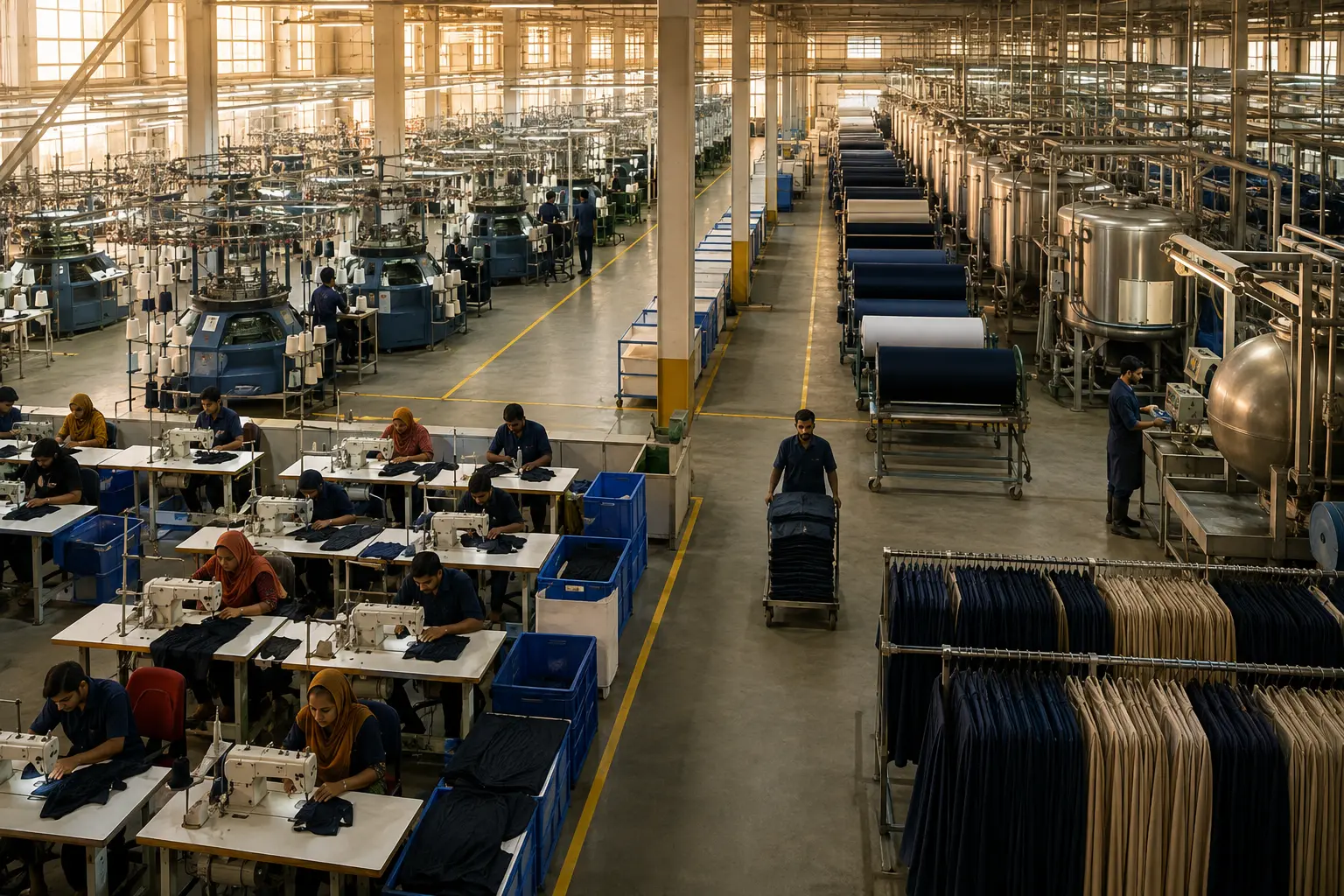
MOQ is usually the first practical question any new buyer asks, and it's also one of the most inconsistently answered — because the honest answer is "it depends," and it depends on more variables than most quotes make clear upfront. Here's what actually shapes it.
MOQ Varies Significantly by Product Category
Standard minimums differ meaningfully across garment types, and lumping them together under one "Bangladesh MOQ" number is where a lot of buyer confusion starts:
Knit basics (T-shirts, polos, sweatshirts) — typically the lowest floor, often starting around 300-1,200 pieces per style per color at established factories.
Woven garments (shirts, trousers, uniforms) — generally higher, often 500-1,000+ pieces, reflecting more complex cutting and construction requirements.
Denim — similarly in the 500-1,000+ range at standard factories, though denim's specialized washing and finishing steps mean MOQ can shift based on wash technique requested.
Flat-knit sweaters and cardigans — a distinct manufacturing discipline (knitted from yarn on knitting machines rather than cut from fabric), often carrying different, sometimes higher, minimums than cut-and-sew knitwear.
Highly specialized items (caps, technical outerwear) — can carry dramatically higher minimums, sometimes in the tens of thousands of units, due to the economics of running specialized machinery.
MOQ Also Varies by Region — This Is Rarely Explained to Buyers
Bangladesh's manufacturing regions have real specializations, and that affects both MOQ and what a factory will realistically prioritize:
Gazipur — home to large, vertically integrated knit producers running yarn-to-garment under one roof, which can mean more flexible, faster-turnaround programs for knitwear specifically.
Narayanganj — the country's denim and wash-house center; most specialized laundries and finishing houses sit here, meaning denim MOQ and lead time questions are best asked of factories in this region specifically.
Chittagong — home to the largest Export Processing Zone and the main seaport; woven, outerwear, and technical categories concentrate here, with proximity to the port cutting inland shipping time.
Mirpur/Ashulia — a hub for sweater and fine-gauge knit production at real scale.
Asking a knitwear-focused Gazipur factory to quote a complex denim wash program, or vice versa, tends to produce the least competitive MOQ and pricing either could offer — matching your product category to a factory's actual specialization matters as much as the raw MOQ number.
The Real Trade-Off: Lower MOQ Isn't Free
A factory willing to accept a smaller order than its standard minimum is usually making a trade somewhere, and buyers should go in understanding what that trade is:
Higher per-unit price — smaller runs don't benefit from the fabric and labor efficiencies of scale, so expect a real premium, not a rounding error.
Lower production priority — smaller orders often get scheduled around larger, established client programs, which can mean a longer or less predictable timeline, particularly during Q3 peak season.
Narrower margin for the factory to absorb quality issues — a factory running thin margins on a small order has less room to make things right if something goes wrong compared to a large, higher-margin program.
None of this means small orders are a bad idea — it means going in with realistic expectations about price and timeline rather than assuming a low-MOQ quote comes with zero trade-offs.
Fabric MOQ vs. Garment MOQ — Confirm Both
This is worth repeating because it's the single most common point of confusion: a factory's stated garment MOQ often doesn't apply per color or fabrication independently. An order of 1,000 pieces split across four colorways can, in practice, mean four sub-orders of 250 — below many factories' actual per-color cutting minimum. Always ask explicitly: does this MOQ apply per style, per color, or per total order? And separately: what's the fabric MOQ, especially for any custom-dyed or specialty material?
If Your Order Is Below Standard MOQ
Consolidate colors or styles rather than splitting a small total order across multiple variants.
Ask directly whether the factory offers a development-stage or lower-MOQ tier — some do, typically at a cost premium, and being upfront about your volume avoids wasted time on both sides.
Be transparent about your actual numbers from the first email. A factory that knows your real volume upfront can tell you quickly and honestly whether you're a fit — a mismatch discovered after samples and negotiation wastes far more time than a direct answer would have.
Consider whether your product category is the constraint, not just your volume. A 500-piece knit tee order and a 500-piece structured denim jacket order face very different MOQ realities at the same volume.
Talking to Warptex About MOQ
[Insert Warptex's actual MOQ by product category, and be specific about which categories Warptex specializes in vs. routes to partner facilities — buyers respond better to a factory that's upfront about what it does and doesn't do well than one that says yes to everything.] [Get in touch to discuss your order size →]