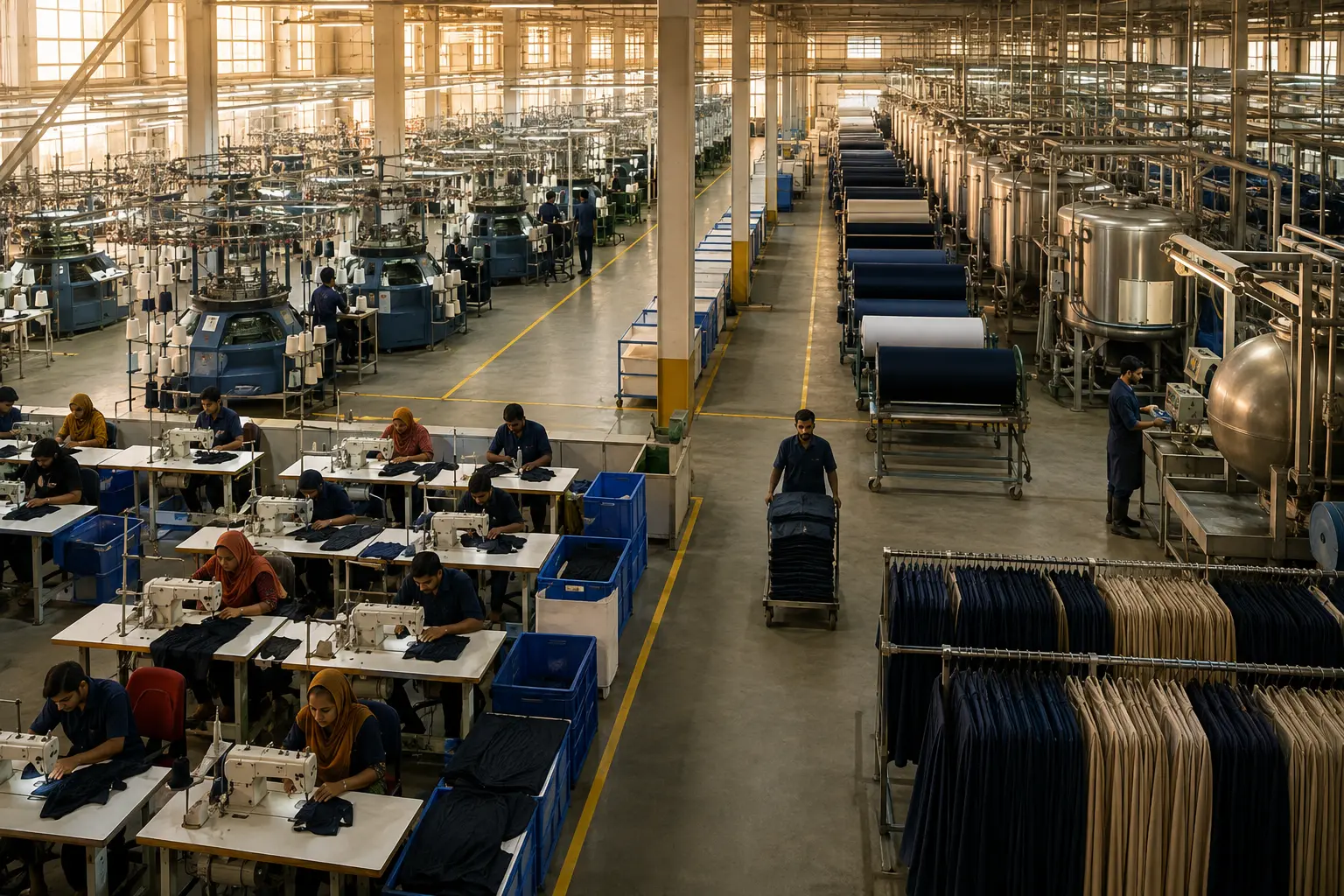
Before choosing a manufacturer, choosing a fabric construction, and before that, understanding which one your product actually needs — knit or woven decisions get made too casually, often based on what looks familiar rather than what the garment needs to do. Here's how to think about it properly.
The Core Mechanical Difference
Knit fabric is built from a single continuous yarn formed into interlocking loops — think of it as industrial-scale knitting. That loop structure is what gives knit fabrics their signature stretch in multiple directions. Woven fabric is made by interlacing two sets of yarns (warp and weft) at right angles on a loom, producing a fabric with far less inherent stretch but significantly more dimensional stability and structure.
The short version: knits flex, wovens hold.
What Knit Fabric Does Well
Stretch and fit forgiveness — natural two-way or four-way stretch (more with added elastane) makes knit garments comfortable across a range of body types and movement, which is why knits dominate T-shirts, activewear, underwear, and close-fitting layers.
Comfort and breathability — the looped structure allows airflow in ways a tight woven construction doesn't.
Faster, often lower-cost production for basics — knit basics generally carry the lowest MOQ floors and fastest turn times of any garment category in Bangladesh specifically, which matters directly for sourcing decisions, not just fabric preference.
The trade-off: knit fabric is less durable over repeated wear (more prone to pilling and stretching out over time) and is genuinely harder to sew cleanly — its stretchiness makes straight, pucker-free seams more technically demanding than most buyers assume.
What Woven Fabric Does Well
Structure and precision — dimensional stability and a smooth, tailored surface make woven fabric the right choice for shirts, trousers, structured outerwear, and formal apparel where fit accuracy matters more than stretch.
Durability — the interlaced construction generally holds up to wear and washing better than knits over the garment's lifecycle.
Predictable sizing — because woven fabric doesn't stretch to accommodate fit variation the way knits do, sizing accuracy in pattern-making becomes more critical, but the result is more consistent garment-to-garment.
The trade-off: woven construction generally means higher MOQ, more complex construction, and — relevant for sourcing decisions specifically — a different regional and factory specialization within Bangladesh's manufacturing base than knit production.
The Middle Ground: Stretch-Wovens and Structured Knits
The line has blurred in recent years. "Stretch-woven" fabrics use technical yarns to add give to a traditionally rigid structure — increasingly common in hiking gear, commuter wear, and anything needing a tailored look with a genuine range of motion. Meanwhile, more heavily engineered knit constructions are picking up structure that used to be exclusively a woven trait. If your product doesn't cleanly fit either traditional category, it's worth asking your manufacturer directly whether a hybrid construction better matches what you're actually trying to achieve, rather than forcing the decision into a strict either/or.
How This Actually Affects Your Sourcing Decision
This isn't just a fabric-science question — it changes who you should be talking to:
Different MOQ realities. Knit basics typically carry the lowest minimums in Bangladesh manufacturing; woven and structured categories generally require higher volume commitments.
Different factory specialization. Not every Bangladesh factory does both well — vertically integrated knit specialists (concentrated in regions like Gazipur) and woven/technical specialists (concentrated in areas like Chittagong) often represent genuinely different production disciplines, not just different machines in the same building.
Different lead times. In-house knit mills can turn cotton jersey in roughly 15-25 days; domestically sourced woven fabric commonly runs 30-45 days before cut-and-sew even begins.
A Simple Way to Decide
Ask: does this garment need to move with the body, or hold its shape against it? A T-shirt, legging, or fitted activewear top needs to flex — knit is almost always the right call. A tailored shirt, structured trouser, or outerwear piece needs to hold a defined shape — woven is generally the better fit. Anything requiring both (performance apparel needing structure and range of motion) is exactly where the stretch-woven/engineered-knit middle ground is worth exploring with your manufacturer directly.
Where Warptex Fits
[Insert Warptex's actual specialization here — which construction(s) Warptex manufactures in-house, and which (if any) are routed to partner facilities. Given how directly this section ties to a sourcing decision, vague or overly broad claims here would undercut the whole point of the post.] [Discuss your product's fabric requirements with us →]