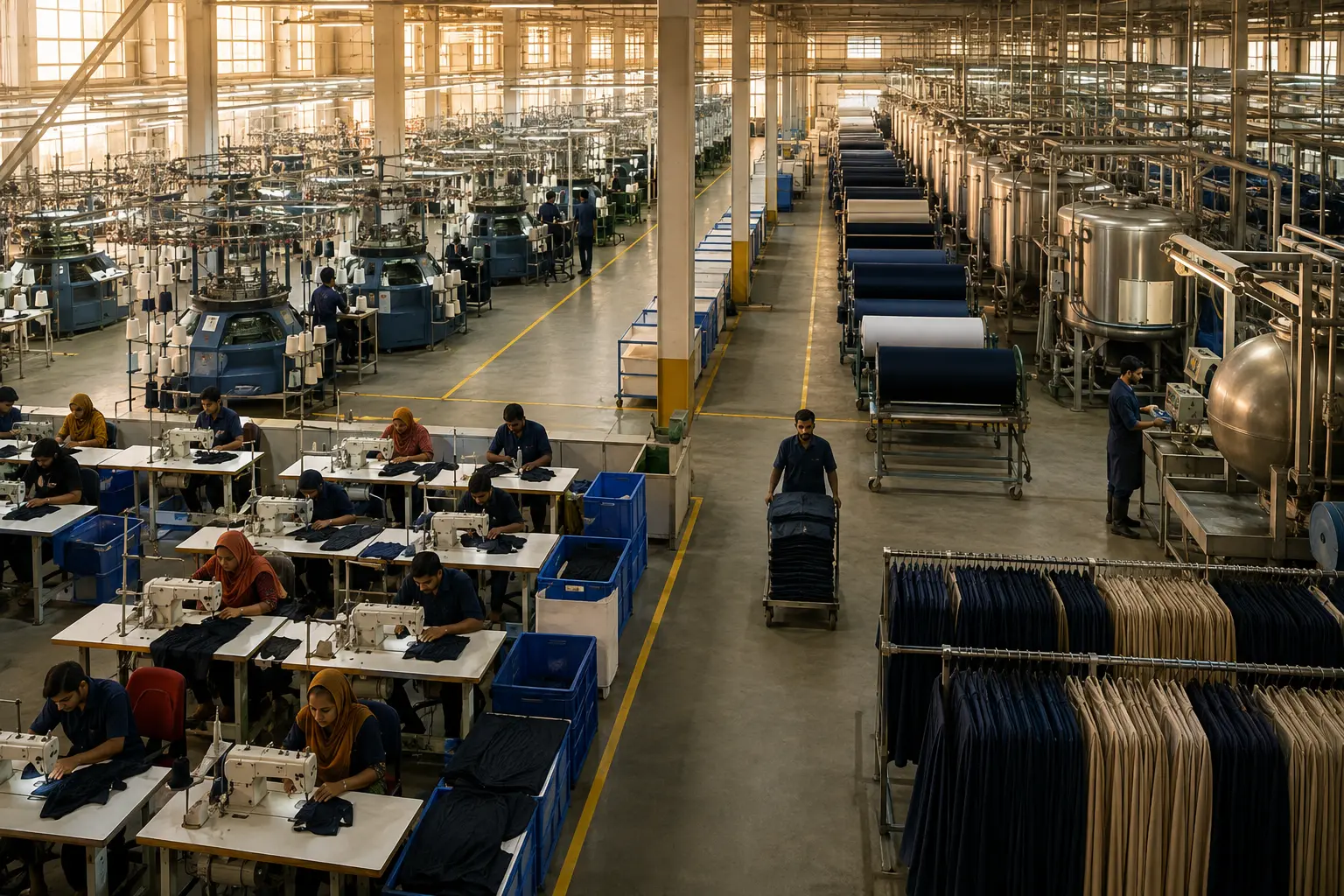
Roughly a third of first-time brand engagements with Bangladesh factories run into a significant issue during production — subcontracting discovered after the fact, fabric substituted from what was agreed, or quality drifting from the approved sample. Most of these are preventable, not by luck, but by checking the right things before a purchase order is signed rather than after. Here's what that actually looks like.
Start With Verifiable Documentation, Not Verbal Assurance
Any factory can say "we're fully compliant." What matters is whether that claim survives a five-minute check:
Cross-check certifications against public registries. GOTS, OEKO-TEX, and SA8000 all maintain public databases where you can verify a certificate number is real, current, and registered to the factory claiming it — not expired, not borrowed from a sister facility.
Ask for the most recent audit report, not just a certificate. A certificate confirms a standard was met at some point; a recent audit report (BSCI/amfori, Sedex/SMETA, or equivalent) shows current standing. A factory that can only produce an old certificate without recent audit backing may not currently meet the standard it's citing.
Confirm which entity the certification actually covers. In factory groups with multiple facilities, compliance depth often varies significantly by individual factory, not just by group name — verify the specific production unit your order will run through, not the parent company's best-certified site.
Watch for These Communication Red Flags
Certain patterns show up disproportionately often in problematic supplier relationships:
WhatsApp-only communication with no verifiable business address or landline. Legitimate factories operate through traceable business channels, not exclusively informal messaging apps.
MOQ inflation after an initial quote. A quoted MOQ that jumps once you're engaged in the process is a common early warning sign, not a one-off negotiation quirk.
Demands for 100% payment upfront. Standard industry practice involves a deposit with balance due against shipment or documents — a factory insisting on full payment before production even starts shifts all the risk onto you.
Reluctance or refusal to provide physical samples before bulk commitment, or unwillingness to have a facility visited or third-party inspected.
No active, current social compliance audit on file at all, particularly for a factory claiming significant scale or brand-name client relationships.
Any one of these alone isn't automatically disqualifying, but more than one together is a real signal to slow down before committing.
Understand What Type of Manufacturer You're Actually Evaluating
Before assessing a specific factory, know what category it falls into:
Vertically integrated manufacturers manage yarn, fabric, dyeing, and finished garment production in-house — generally offering more direct quality control and fewer external dependencies.
Cut-and-sew-only factories source fabric from external mills or traders — perfectly viable, but it adds a link in the chain worth understanding, since fabric quality and delivery timing then depend on a party you're not directly vetting.
Buying houses/agents don't manufacture at all — they coordinate between you and a factory. Useful for some buyers, but confirm you know whether you're evaluating the actual production facility or an intermediary representing one.
Ask About Subcontracting Directly
Order confirmation doesn't guarantee the factory you vetted is the one actually producing your goods. Ask directly whether any portion of production — cutting, sewing, washing, finishing — is subcontracted to another facility, and if so, which one and under what oversight. Subcontracting isn't inherently a problem, but undisclosed subcontracting removes the entire point of vetting the original factory in the first place.
Factor In the Calendar
Bangladesh's monsoon season (roughly June through September) can disrupt inland transport and fabric finishing schedules, and the Q3 period tends to be an industry-wide peak season. Vetting a factory in isolation from timing means missing a real variable — a factory that performs well outside peak season may face genuine capacity strain when everyone else is also placing Q3 orders. Ask directly how a prospective factory handles seasonal capacity crunches, not just their best-case lead time.
Questions Worth Asking Any Factory — Including Warptex
Can you show me your current certifications and the most recent audit report for the specific facility that will produce my order?
Is any part of my order subcontracted, and if so, to whom?
What's your realistic MOQ for both the garment and the specific fabric I need?
What's your standard payment structure, and why?
Can I visit the facility, or arrange a third-party inspection, before committing to a bulk order?
Any manufacturer worth working with — including Warptex — should be able to answer all five of these clearly and without hesitation. If a factory hedges on more than one, treat that as useful information, not an inconvenience to push past.
[See Warptex's current certifications →] [Get in touch to discuss your sourcing evaluation →]