Most quoted lead times describe the factory's clean production window — the time between an approved sample, confirmed fabric, and a paid deposit. Your real timeline, from first inquiry to goods arriving at your warehouse, usually runs three to five weeks longer than that quoted number. Here's what actually fills that gap, stage by stage.
Stage 1: Sampling — 2 to 5 Weeks (Often Longer)
This is the stage buyers most consistently underestimate. A typical program requires two to three sample rounds, with each development sample taking roughly one to two weeks depending on garment complexity. Pattern development, cutting, sewing, and finishing the first sample is only part of it — fit corrections, fabric substitutions, and revision cycles are normal, not a sign something's gone wrong. The honest bottleneck here is often the buyer's own turnaround time on feedback and approval, not the factory's sample-making speed. A factory that returns samples quickly but waits two weeks for your sign-off has the same net delay as a slow factory — the schedule doesn't distinguish between the two.
Stage 2: Fabric and Trim Sourcing — 1 to 6 Weeks, Often Parallel to Sampling
If fabric is already in stock or a standard, readily available material, sourcing can run in parallel with sampling and add minimal time. Custom colors, made-to-order dyeing, or specialty trims are a different story — budget two to four additional weeks for custom-dyed or specially developed fabric. Imported fabric (common for technical or specialty constructions not produced domestically) adds further time for inland and ocean transit before production can even begin. This is also where fabric MOQ can quietly extend a timeline: a factory waiting on a minimum dye-lot run for your specific color adds real weeks that a generic "production timeline" estimate won't show.
Stage 3: Bulk Production — 3 to 8 Weeks
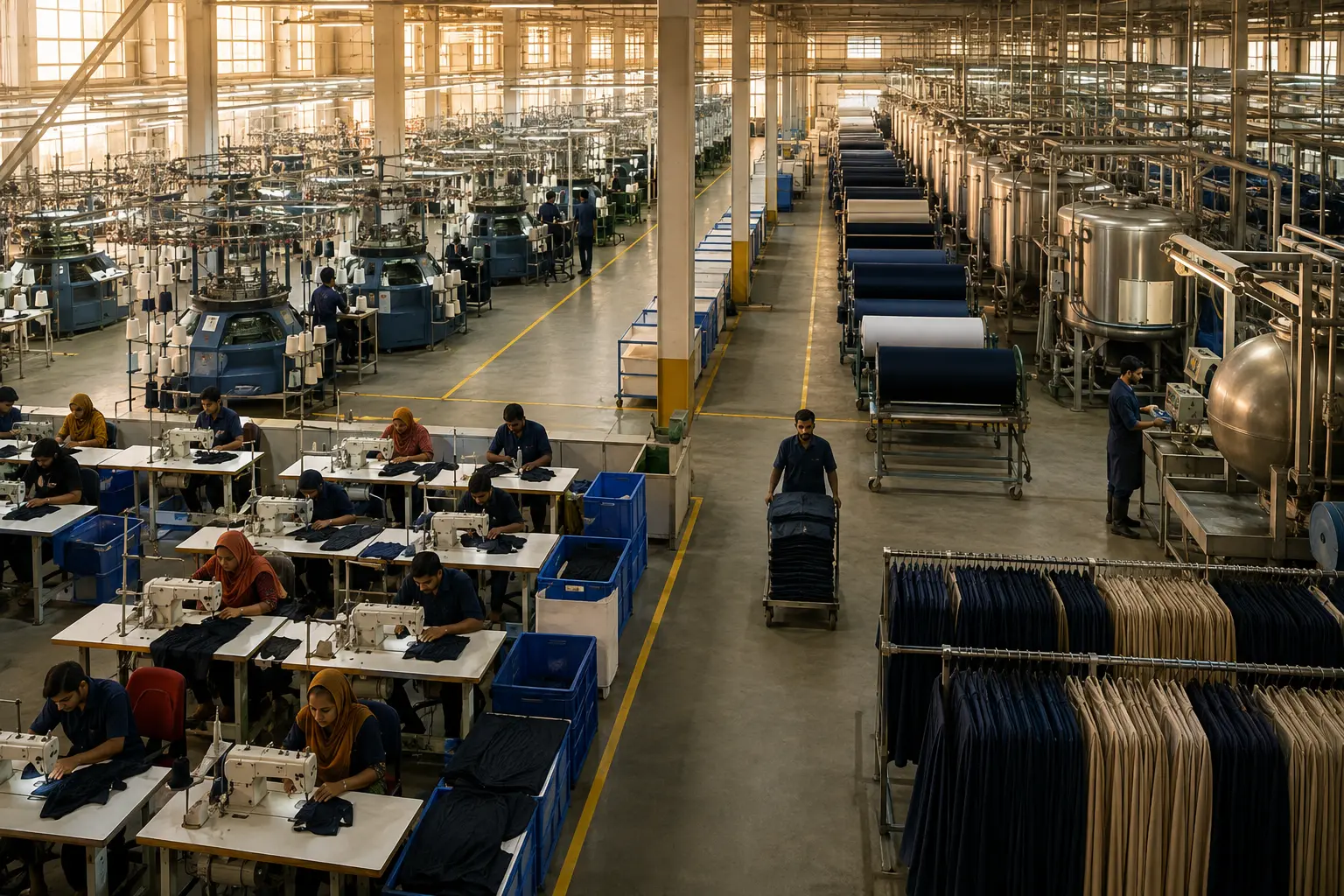
Cutting, sewing, and finishing happen here, and your order is sharing factory floor time with every other client's order — a busy factory means your production slot is real, not guaranteed the moment you sign. As a general benchmark, in-house knit mills can turn cotton jersey in roughly 15-25 days, while woven fabric sourced domestically runs closer to 30-45 days. Total PO-to-FOB timelines commonly land around 75-120 days for knit programs and 90-130 days for denim or more complex woven construction — with Q3 peak season adding a further 15-25% on top as factories manage higher overall demand.
Stage 4: Quality Control — Layered Throughout, Minimal Added Time
Inspection happens at multiple points rather than as a single bottleneck at the end — fabric checked on arrival, in-line checks during sewing, and a final pre-shipment inspection before packing. Done properly, quality control adds little to overall timeline, since it's built into the existing production window rather than bolted on afterward. (For the full process, see our quality control deep-dive.)
Stage 5: Packing and Shipping — Days to Weeks, and Currently Less Predictable Than Usual
Sea freight is the standard, cost-effective option but takes weeks depending on destination; air freight runs 3-7 days but at a significant cost premium, generally reserved for samples or urgent partial shipments rather than full bulk orders. Worth knowing right now specifically: regional shipping disruptions affecting Middle East corridors have made transit timing less predictable through parts of 2026 than usual. If your route runs through an affected corridor, build in extra buffer between finishing production and booking the shipment — a two-to-three-week shipping delay on an otherwise on-time order is a real possibility in the current environment, not a hypothetical.
Factor In Bangladesh's Holiday Calendar
Bangladesh observes two Eid holidays annually, during which factories typically close for roughly 7-10 days each. A production window that quietly overlaps one of these closures without accounting for it is a common, entirely avoidable source of missed delivery dates — ask your factory directly whether your target production window crosses either holiday period.
A Realistic Total Timeline
Putting it together, a full first-time order — from initial sample request to goods on a ship — commonly runs somewhere in the range of 3 to 5 months for standard knit or woven programs, longer for denim or highly customized construction, and longer still if your fabric requires custom development or if your order lands in Q3 peak season. Repeat orders with an established factory relationship, approved base samples, and pre-confirmed fabric can move meaningfully faster than a first-time program.
How to Actually Shorten Your Timeline
The honest answer isn't expediting production — it has hard physical limits and often carries a real cost premium (commonly 10-20% for rush production). The more reliable levers:
Approve samples quickly and decisively. This is the single biggest lever in your control, and the one most buyers underuse.
Book fabric early, especially anything custom-dyed or made-to-order.
Plan around Bangladesh's holiday calendar and Q3 peak season rather than discovering the overlap mid-schedule.
Build shipping buffer into your plan right now, given current regional transit unpredictability — don't assume the historical average holds through this period.
Working Backward From Your Launch Date
Rather than asking "how fast can you go," the more useful planning question is: work backward from your actual need-by date, add the realistic stage-by-stage timeline above, then add a buffer — not because your factory is unreliable, but because sampling delays, holiday overlaps, and current shipping variability are all real, common, and mostly foreseeable if you plan for them upfront.
[Talk to us about your timeline before you commit to a launch date →]