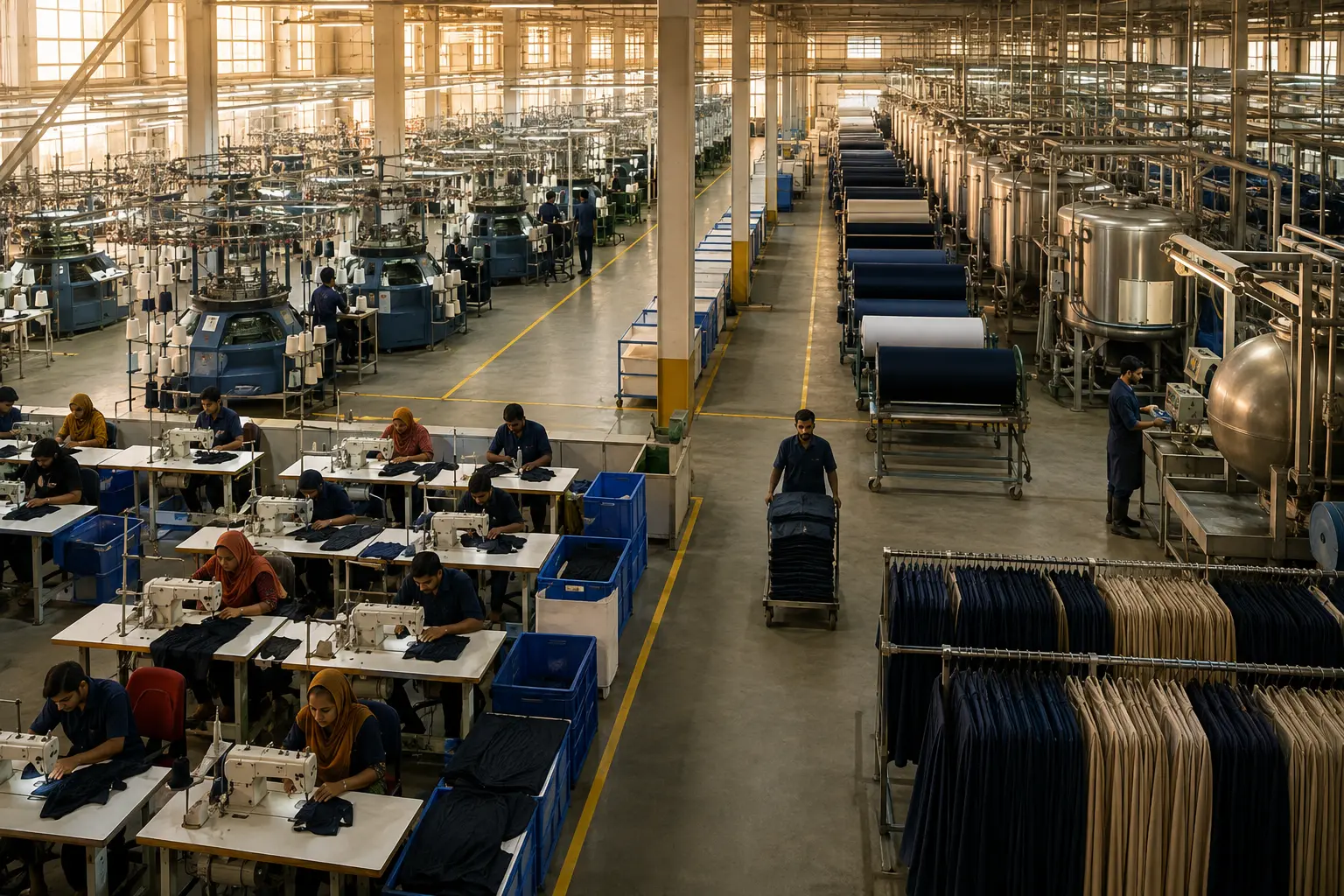
Bangladesh and Vietnam are consistently the two names that come up when buyers look beyond China, and unlike the Bangladesh-China comparison, this one isn't about one country's decline — both are genuinely strong, growing sourcing destinations with real, different strengths. The right answer depends far more on your specific product category than on which country is "better" overall.
Where Bangladesh Wins
Cost on high-volume basics. Bangladesh consistently runs lower per-unit on commodity cotton knitwear and denim at scale — commonly cited at $1.50-3.00 lower per unit on styles above 5,000 pieces.
Compliance infrastructure depth. Following the 2013 Rana Plaza collapse, Bangladesh built out the Accord/RSC building and fire safety mechanism covering roughly 1,600 export factories, alongside a large base of SMETA, BSCI, and WRAP certified facilities. Buyers with strict vendor compliance requirements will generally find a larger certified factory pool in Bangladesh than in Vietnam's smaller (though growing) compliance base.
UK market access. Bangladesh qualifies for the UK's Developing Countries Trading Scheme with near-zero tariffs; Vietnam does not currently have a comparable UK trade agreement, creating a real cost gap for buyers selling into UK retail specifically.
EU duty treatment (through the transition period). Bangladesh's Everything But Arms access remains in place through a multi-year transition following November 2026 LDC graduation, while Vietnam's EVFTA tariff reductions require meeting yarn-forward rules of origin — yarn spun and fabric made in Vietnam or a qualifying partner — which cut-and-sew-only production doesn't satisfy.
Where Vietnam Wins
Technical and performance categories. Vietnam has built the deeper capability base in activewear, technical outerwear, and complex wovens — which is why major performance and outdoor brands anchor significant production there.
Lower MOQ accessibility. Small CMT factories in Vietnam commonly accept 150-500 pieces per style, meaningfully below typical Bangladesh minimums for equivalent categories — a real advantage for smaller or earlier-stage brands.
Broader FTA network for non-US markets. Vietnam's CPTPP membership gives zero-tariff access to Japan, Canada, and Australia; EVFTA is progressively cutting EU tariffs toward 0% for qualifying goods. For buyers whose primary markets are Pacific Rim or EU (and who can meet rules-of-origin requirements), this can outweigh Bangladesh's per-unit cost edge.
Faster general lead times at tier-one facilities, though tier-one Vietnam capacity is often booked out significantly in advance during peak periods.
The US Tariff Picture Is Currently the Most Volatile Variable
This is the factor most likely to change again before you finish reading this post. Recent US tariff policy has moved from country-specific "reciprocal" rates toward a flatter Section 301 forced-labor tariff structure, and the reported rates under this new system put Bangladesh at a lower tier than Vietnam — a meaningful reversal from the prior structure, where Vietnam's rate was reported significantly higher than Bangladesh's. Given how recently and dramatically this shifted, buyers making US-market sourcing decisions should verify current rates directly (USTR guidance or a customs broker) rather than relying on any single source's snapshot, including this one.
Choosing by Product Category, Not by Country
Basic cotton knitwear or denim at volume (5,000+ units) → Bangladesh's cost advantage is hard for Vietnam to match without margin compression.
Activewear, technical outerwear, or complex performance fabrics → Vietnam's fabric access and technical sewing capability generally produce a better result.
Small-batch or early-stage brand orders → Vietnam's lower MOQ floor may be the more practical starting point regardless of category.
UK-bound orders → Bangladesh's current duty treatment gives a clear, quantifiable cost edge.
EU or Pacific Rim-bound technical goods that can meet rules-of-origin requirements → Vietnam's FTA network may outweigh Bangladesh's baseline cost advantage.
What This Means for Your Sourcing Strategy
Many established buyers run both — Bangladesh for high-volume basics, Vietnam for technical and smaller-batch categories — rather than committing exclusively to one. If your product mix spans both categories, that split may serve you better than forcing a single-country decision. If you're concentrated in commodity knitwear or denim at real scale, Bangladesh's structural cost and compliance advantages are difficult for Vietnam to match on those specific terms.
[Discuss your product mix and sourcing strategy with our team →]