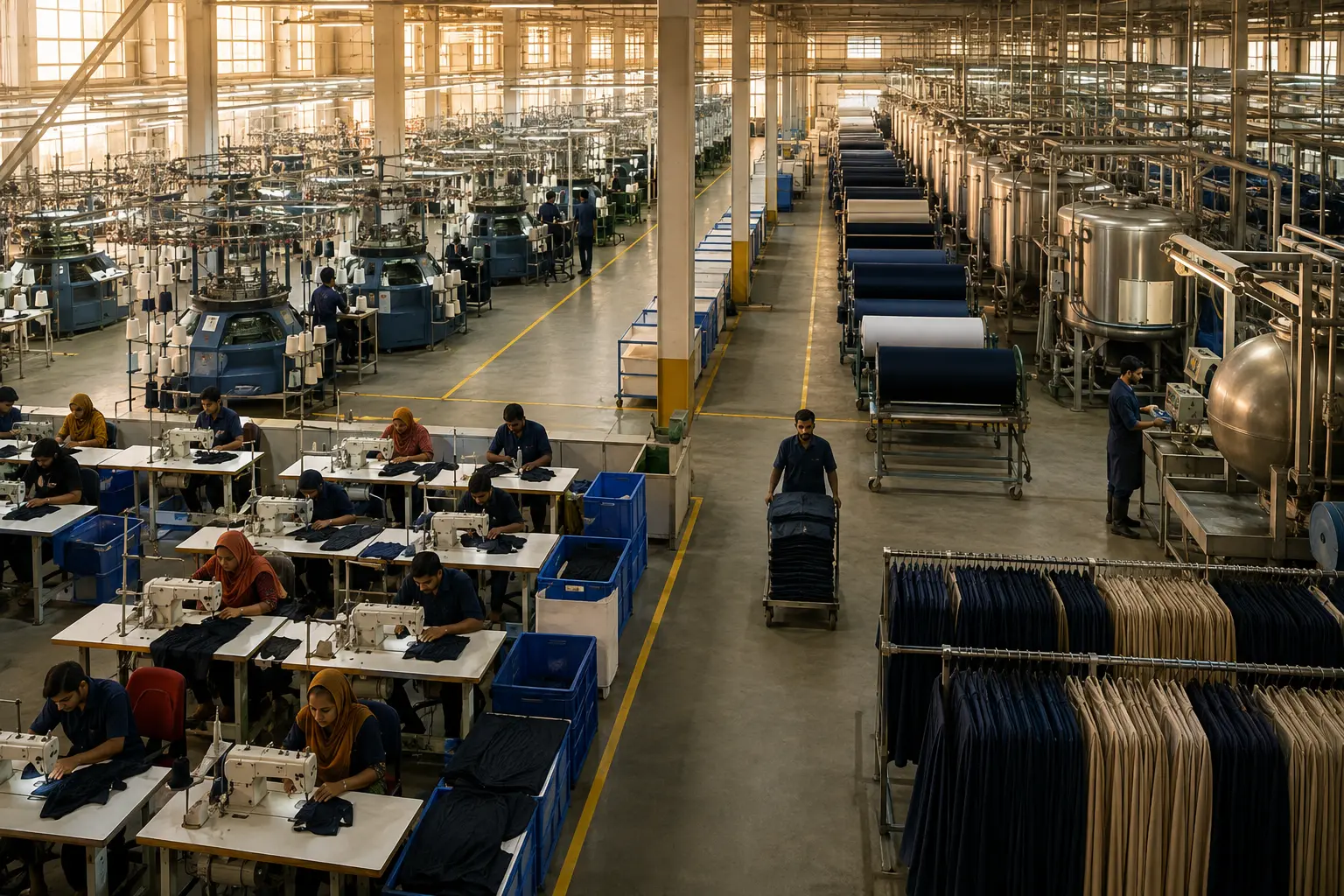
Sustainability claims are easy to make and hard to verify — which is exactly the problem buyers face when evaluating garment manufacturers. Bangladesh's apparel industry has increasingly treated sustainability as a genuine competitive differentiator rather than a compliance checkbox, and Warptex's approach is built around the same principle: practices that can actually be checked, not just asserted.
Certifications as the Starting Point, Not the Whole Story
Warptex holds certifications across the standards buyers most commonly require: GOTS (Global Organic Textile Standard) for organic fiber integrity, GRS (Global Recycled Standard) for recycled-content verification, OEKO-TEX Standard 100 for chemical safety in finished textiles, and ZDHC (Zero Discharge of Hazardous Chemicals) alignment for wastewater and chemical management. Alongside these, WRAP, BSCI, and Sedex membership cover social compliance and ethical labor practices, and ISO 9001:2015 underpins quality management systems.
Certifications matter, but they're a floor, not a ceiling — they confirm a manufacturer meets a defined standard, not that sustainability is embedded in day-to-day production decisions. That's the distinction buyers should actually be probing for.
Water and Chemical Management
Textile production is water- and chemical-intensive by nature, and Bangladesh's manufacturing sector has invested significantly in Effluent Treatment Plants (ETPs) and, at leading facilities, Zero Liquid Discharge (ZLD) systems to manage this. Chemical inputs are managed against ZDHC's Manufacturing Restricted Substances List (MRSL) framework, which governs which substances can be used in production and at what thresholds — the same framework increasingly required by major international brands as a baseline sourcing requirement, not an optional extra.
Circularity and Material Sourcing
The industry-wide shift toward circular fashion — recycled cotton and polyester content, verified through GRS certification, and initiatives to recycle pre-consumer textile waste ("jhoot") back into usable yarn — reflects a genuine change in how raw materials move through Bangladesh's supply chain, not just a marketing narrative. For buyers with recycled-content requirements in their own product lines, working with GRS-certified manufacturers is what makes those claims verifiable further up the chain, rather than resting on an unaudited assertion.
Energy and Facility Standards
Bangladesh is home to one of the highest concentrations of LEED-certified green garment factories in the world, and government incentives — including reduced corporate tax rates for certified green facilities and low-interest financing through the Green Transformation Fund — have accelerated investment in energy-efficient manufacturing infrastructure across the sector. Facility-level environmental performance is increasingly something buyers can verify directly rather than take on faith.
Why This Matters More as LDC Graduation Approaches
As Bangladesh transitions out of Least Developed Country status in November 2026, sustainability compliance is shifting from a competitive advantage to a structural requirement — post-graduation trade frameworks generally carry stricter environmental and labor standards than LDC-era terms did. Manufacturers who already operate at these standards won't need a remediation period as new requirements phase in; manufacturers who don't will.
What Buyers Should Actually Ask
Rather than taking "we're committed to sustainability" at face value from any supplier, ask for:
Current certificates (GOTS, GRS, OEKO-TEX, ZDHC, BSCI/Sedex) with valid dates, not expired ones
Specifics on wastewater treatment infrastructure (ETP vs. ZLD)
Recycled-content sourcing and traceability documentation if relevant to your product line
Evidence of ongoing internal audits, not just the original certification date
Warptex's certifications and compliance framework are outlined in full on our [Compliance & Ethics page →], and our production and QA/QC teams can walk through specific documentation as part of any sourcing evaluation. [Get in touch →]