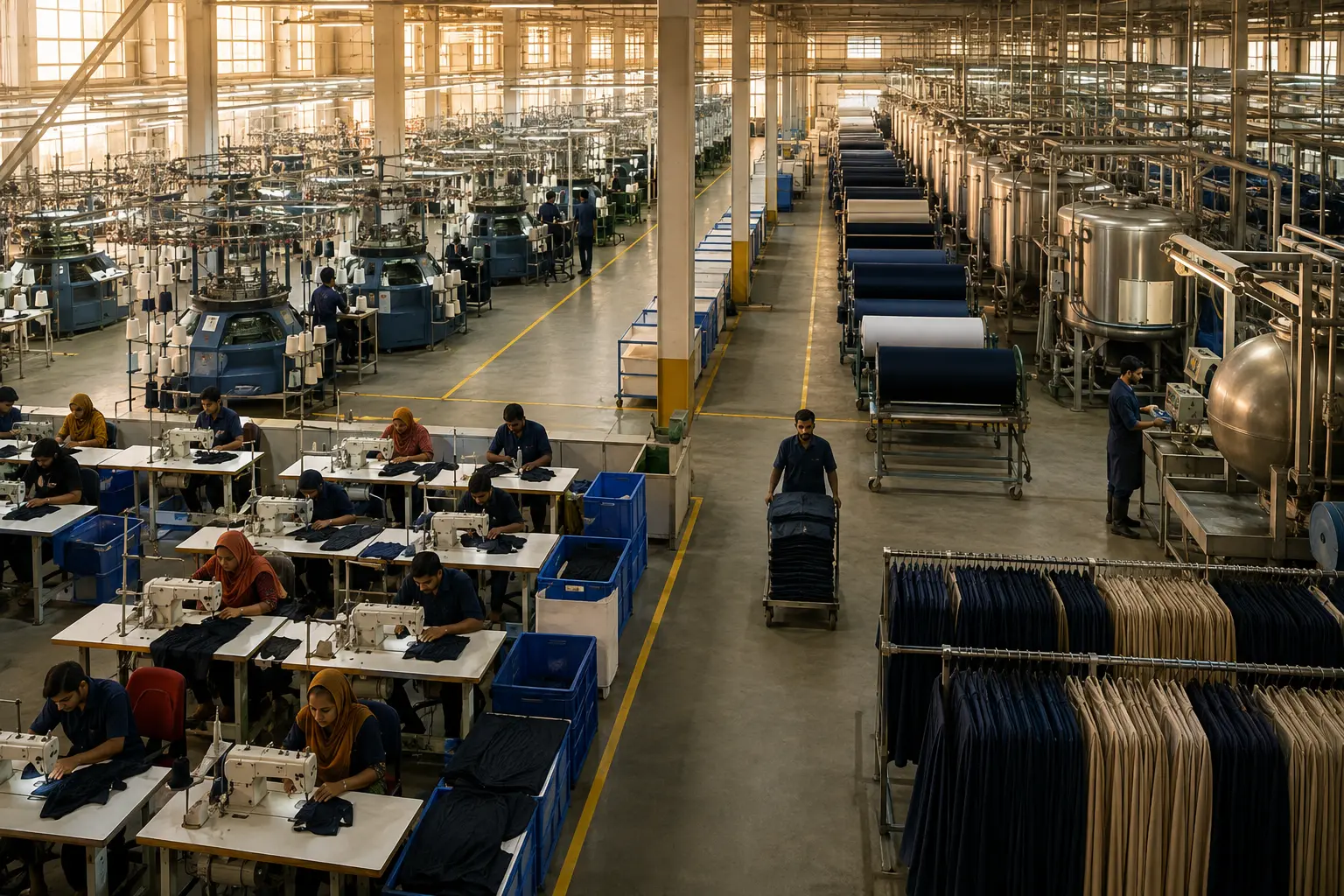
Introduction: Understanding the Bangladesh Garments Industry
The global fashion and apparel industry depends on a complex international supply chain involving raw material suppliers, textile mills, garment manufacturers, sourcing companies, logistics providers, distributors and retailers. Among the countries playing a significant role in this global ecosystem, Bangladesh has established itself as one of the most important destinations for ready-made garment manufacturing.
The Bangladesh garments industry, commonly known as the Ready-Made Garments (RMG) industry, is one of the country's largest industrial sectors and its most important export-oriented manufacturing industry. It produces a wide range of clothing products for international fashion brands, retailers, wholesalers and private-label businesses.
From basic cotton T-shirts and polo shirts to denim jeans, woven shirts, sweaters, jackets, sportswear and sophisticated fashion apparel, Bangladeshi manufacturers supply products to customers across Europe, North America, Asia and other international markets.
Bangladesh has developed a strong manufacturing ecosystem supported by an experienced workforce, established production infrastructure, competitive manufacturing capabilities, textile suppliers, accessories manufacturers, washing facilities and international logistics networks.
According to Bangladesh Bank's FY2024–25 annual reporting, ready-made garment exports reached approximately US$39.35 billion, representing a substantial share of Bangladesh's merchandise exports. The same sector contributed approximately 8.52% of nominal GDP in FY2024–25 according to Bangladesh Bank's subsequent quarterly RMG review.
Bangladesh Bank+1
However, the industry's importance goes beyond export revenue. It supports millions of livelihoods, encourages industrial development, creates opportunities for women in manufacturing, attracts foreign buyers and strengthens Bangladesh's position in the global apparel supply chain.
For international buyers, understanding the Bangladesh garments industry is essential when evaluating manufacturing destinations, selecting suppliers, negotiating production contracts, managing quality requirements and developing long-term sourcing strategies.
This comprehensive guide explains the Bangladesh apparel manufacturing ecosystem from A to Z, covering its history, production processes, fabrics, garment categories, merchandising, quality assurance, compliance, sustainability, exports, sourcing strategies, challenges and future opportunities.
Whether you are an international apparel buyer, fashion brand owner, sourcing professional, importer, retailer or garment industry investor, this guide will help you understand how Bangladesh's garment manufacturing sector operates and how to work with its suppliers effectively.
Table of Contents
Overview of the Bangladesh Garments Industry
History and Development of the RMG Industry
Why Bangladesh Is a Global Garment Manufacturing Destination
Major Garment Products Manufactured in Bangladesh
Understanding the Textile and Apparel Supply Chain
Types of Garment Manufacturing: Knitwear vs Woven
Raw Materials Used in Garment Manufacturing
Garment Manufacturing Process: Step-by-Step
Garment Merchandising and Product Development
Garment Quality Control and Quality Assurance
Social Compliance and Factory Safety
Sustainable and Ethical Garment Manufacturing
Garment Export Markets and International Trade
How International Buyers Can Source Garments from Bangladesh
Bangladesh Compared with Other Garment Manufacturing Countries
Technology and Automation in the Garment Industry
Challenges Facing the Bangladesh Garments Industry
Investment Opportunities in Bangladesh's Apparel Sector
The Future of the Bangladesh Garments Industry
Essential Garment Industry Terminology
Frequently Asked Questions
Conclusion
References and Further Reading
1. Overview of the Bangladesh Garments Industry
The Bangladesh garments industry is an export-oriented manufacturing sector that specializes in producing finished clothing products for international markets.
The sector includes thousands of interconnected businesses, including:
Ready-made garment factories
Textile and spinning mills
Knitting and weaving facilities
Dyeing and finishing plants
Garment washing factories
Embroidery and printing facilities
Accessories and packaging manufacturers
Apparel buying houses
Sourcing and inspection companies
Freight forwarding and logistics providers
These businesses work together to transform raw materials into finished apparel products ready for international distribution.
1.1 What is the RMG industry?
RMG stands for Ready-Made Garments.
It refers to clothing manufactured in standardized production facilities rather than individually tailored for each customer.
The RMG industry includes different stages of production, such as fabric preparation, pattern development, cutting, sewing, finishing, quality inspection, packaging and shipment.
For example, producing a cotton T-shirt for an international fashion retailer may involve:
Purchasing cotton yarn or finished fabric.
Knitting the fabric into the required structure.
Dyeing and finishing the fabric.
Developing the garment pattern.
Cutting fabric according to approved measurements.
Sewing individual garment components.
Conducting quality inspections.
Applying labels and packaging.
Shipping the finished garments to the buyer.
This entire process is part of the ready-made garment manufacturing ecosystem.
1.2 Economic importance of the industry
The RMG industry plays a critical role in Bangladesh's economy.
Its contribution includes:
Foreign exchange earnings.
Industrial employment.
Women's economic participation.
Development of supporting industries.
International trade relationships.
Infrastructure and logistics development.
Growth of banking and financial services.
Expansion of textile and accessories manufacturing.
Bangladesh Bank reported RMG exports of approximately US39.35billioninFY2024–25.KnitwearcontributedapproximatelyUS21.16 billion, while woven garments contributed approximately US$18.18 billion in the same fiscal year.
Bangladesh Bank+1
Bangladesh RMG export performance — FY2024–25
US$39.35B
Total RMG exports
8.52%
Share of nominal GDP
US$21.16B
Knitwear exports
US$18.18B
Woven garment exports
Source: Bangladesh Bank, FY2024–25. Export values are rounded.
1.3 The role of Bangladesh in global fashion
Bangladesh is particularly important for brands that need large-scale apparel production with competitive pricing and established manufacturing infrastructure.
Its factories manufacture products for:
International fashion retailers.
Global supermarket chains.
Sportswear brands.
Department stores.
Private-label clothing companies.
E-commerce fashion businesses.
Promotional apparel distributors.
Uniform and workwear suppliers.
The country's manufacturing capabilities make it relevant for both basic apparel and increasingly sophisticated product categories.
However, the suitability of a particular supplier depends on its machinery, production experience, quality systems, compliance status, capacity and product specialization.
2. History and Development of the RMG Industry
Bangladesh's Paradox for Poor Women Workers - Bloomberg
The development of Bangladesh's garments industry is one of the most significant industrial transformation stories in South Asia.
Although Bangladesh has a long history of textile production and traditional clothing craftsmanship, the modern export-oriented RMG sector began developing in the late 1970s and expanded rapidly during the 1980s and 1990s.
2.1 Early beginnings
Before the expansion of export-oriented garment manufacturing, Bangladesh had a relatively small industrial base.
Traditional textiles, handloom products and local tailoring businesses were important parts of the country's clothing ecosystem.
However, the country needed new export industries to diversify its economy and generate foreign exchange.
During the late 1970s, entrepreneurs began exploring opportunities in international apparel manufacturing.
One of the pioneers was Nurool Quader Khan, who helped establish the foundations of Bangladesh's modern garment manufacturing industry.
In 1978, he sent a group of trainees to South Korea to learn garment production techniques. These trainees later contributed to the establishment of Desh Garments, an early export-oriented garment manufacturing enterprise.
About Garment Industry of Bangladesh+1
2.2 Expansion during the 1980s
The 1980s marked the beginning of rapid industrial growth.
Several entrepreneurs established garment factories to manufacture clothing for international buyers.
During this period, the industry benefited from:
Growing international demand for affordable apparel.
Access to international buyers.
Expansion of export-oriented industrial policies.
Availability of a large workforce.
Increasing investment in manufacturing facilities.
The number of garment factories increased significantly during this period.
2.3 Rapid growth during the 1990s
The 1990s were a transformative period.
Bangladesh increasingly became a major sourcing destination for international apparel brands.
The industry expanded its product range and manufacturing capabilities.
According to historical statistics compiled by BGMEA, RMG exports increased from approximately US1.45billioninFY1992–93tomorethanUS4 billion by the end of the decade.
Export Performance+1
Several factors contributed to this expansion:
International sourcing diversification.
Competitive manufacturing costs.
Development of knitwear and woven production.
Increasing investment in textile mills.
Expansion of export infrastructure.
2.4 Growth during the 2000s and 2010s
During the 2000s, Bangladesh strengthened its position as an international apparel supplier.
The industry expanded into:
Denim manufacturing.
Sweater production.
Sportswear.
Casualwear.
Outerwear.
Specialized knit products.
Home textiles.
The Rana Plaza disaster in 2013 became a major turning point for industrial safety and factory compliance.
The incident exposed serious weaknesses in building safety and worker protection. It also accelerated international initiatives to improve factory conditions.
Subsequent years saw significant investments in structural safety, fire protection, electrical systems and factory inspection.
2.5 Modern development and global competitiveness
Today, Bangladesh is recognized as one of the world's leading ready-made garment exporters.
The country continues to develop its capabilities in:
High-value apparel.
Technical textiles.
Sustainable production.
Advanced denim.
Man-made fibre garments.
Automated manufacturing.
Product development.
Supply chain transparency.
The next phase of development will depend on productivity, innovation, responsible manufacturing and the ability to produce more sophisticated products.
3. Why Bangladesh Is a Global Garment Manufacturing Destination
Bangladesh boasts 171 Leed-certified green RMG factories now
Mother Textile eyes 100pc of recycled yarn market | The Business Standard
Bangladesh exports up 15% as global demand for garments rebounds | Reuters
12
International buyers evaluate several factors when selecting an apparel manufacturing country.
These include manufacturing costs, product quality, production capacity, delivery reliability, supplier experience, logistics, trade preferences and compliance.
Bangladesh has developed a competitive position across many of these areas.
3.1 Competitive manufacturing capabilities
Bangladesh has a large manufacturing ecosystem with experience in producing high-volume apparel orders.
Its factories manufacture a broad range of products, from basic T-shirts to denim trousers and knitted sweaters.
The country's established supplier network allows international buyers to source multiple product categories within the same manufacturing market.
3.2 Experienced workforce
The RMG industry employs a large workforce with experience in garment production, sewing operations, finishing, quality inspection and merchandising.
This accumulated industrial knowledge helps factories manage complex manufacturing operations.
The workforce also includes experienced technical professionals such as:
Production managers.
Industrial engineers.
Quality controllers.
Pattern technicians.
Textile engineers.
Garment merchandisers.
Compliance officers.
Supply chain professionals.
3.3 Established textile and accessories supply chains
A strong apparel manufacturing industry requires more than sewing factories.
Bangladesh has developed supporting industries in:
Yarn manufacturing.
Knitting.
Weaving.
Dyeing.
Washing.
Printing.
Embroidery.
Labels.
Buttons.
Zippers.
Cartons.
Polybags.
These supporting industries help factories manage procurement and production schedules more efficiently.
3.4 Strong knitwear manufacturing ecosystem
Bangladesh has particularly developed capabilities in knitwear manufacturing.
Common products include T-shirts, polo shirts, sweatshirts, underwear, leggings and sweaters.
The availability of knitting mills and related finishing facilities supports integrated production for many knitwear categories.
3.5 Competitive export infrastructure
Bangladesh's major manufacturing clusters are connected to important export logistics facilities.
The country's major export infrastructure includes:
Chattogram Port.
Dhaka-area air cargo facilities.
Inland container depots.
Road transportation networks.
Freight forwarding services.
Customs and export processing systems.
For international buyers, logistics performance should be evaluated at the factory and shipment level rather than assumed from the country's overall infrastructure.
3.6 Green manufacturing leadership
Bangladesh has become an important example of green factory development in the global apparel industry.
According to the Bangladesh Investment Development Authority, the country has more than 230 LEED-certified factories.
Invest Bangladesh
Green building certification can reflect improvements in energy efficiency, water management, materials and indoor environmental quality.
However, a green factory certificate does not automatically guarantee that every product manufactured there has a lower environmental footprint. Buyers should examine product-level environmental data as well.
3.7 Trade access and sourcing diversification
Bangladesh has benefited from preferential trade arrangements in several international markets.
However, trade preferences depend on destination-country rules, product classification, rules of origin and the applicable trade agreement.
International buyers should assess these factors before making landed-cost decisions.
4. Major Garment Products Manufactured in Bangladesh
Bangladesh Garment Factory - Surplus Overruns for Wholesale
Factory Gallery | SMUG Sweater Ltd.
12
Bangladesh manufactures a wide range of apparel products for different market segments.
Understanding product categories helps buyers identify manufacturers with relevant technical capabilities.
4.1 Knitwear products
Knitwear is one of the strongest segments of Bangladesh's garment manufacturing industry.
Knit fabrics are made by interlooping yarns, creating structures that are generally more flexible and stretchable than woven fabrics.
Common knitwear products include:
T-shirts.
Polo shirts.
Sweatshirts.
Hoodies.
Tank tops.
Leggings.
Sportswear.
Underwear.
Nightwear.
Babywear.
Knit dresses.
Knitwear manufacturing requires expertise in fabric construction, shrinkage control, dyeing, sewing and finishing.
4.2 Woven garments
Woven garments are produced using fabrics made by interlacing warp and weft yarns.
These fabrics are generally more dimensionally stable than knitted fabrics.
Major woven products include:
Formal shirts.
Casual shirts.
Trousers.
Denim jeans.
Chinos.
Jackets.
Skirts.
Dresses.
Shorts.
Uniforms.
Workwear.
Woven manufacturing requires specialized cutting, stitching, seam construction and garment finishing techniques.
4.3 Denim garments
Columbia Washing Plant Limited
Denim is an important apparel category in Bangladesh.
The country manufactures:
Jeans.
Denim jackets.
Denim shirts.
Denim shorts.
Denim skirts.
Fashion denim products.
Denim production may involve multiple processes, including fabric weaving, indigo dyeing, garment cutting, sewing, washing and finishing.
Popular denim treatments include:
Enzyme washing.
Stone washing.
Bleaching.
Whiskering.
Hand sanding.
Resin finishing.
Laser finishing.
Buyers should pay particular attention to colour consistency, dimensional stability, wash effects and chemical management.
4.4 Sweaters and knitwear
Bangladesh has developed considerable experience in sweater manufacturing.
Products include:
Pullover sweaters.
Cardigans.
Knit tops.
Fine-gauge sweaters.
Chunky sweaters.
Jacquard sweaters.
Intarsia sweaters.
Sweater production requires specialized knitting machines, yarn selection, linking, washing and finishing capabilities.
4.5 Sportswear and performance apparel
Sportswear is an increasingly important product category.
It includes:
Training T-shirts.
Running shorts.
Activewear leggings.
Sports bras.
Track jackets.
Performance tops.
Compression garments.
Team uniforms.
These products may require functional fabrics with moisture management, stretch recovery, breathability and durability.
4.6 Outerwear and jackets
Bangladesh also manufactures:
Lightweight jackets.
Puffer jackets.
Windbreakers.
Fleece jackets.
Softshell jackets.
Rainwear.
Insulated outerwear.
Outerwear manufacturing requires advanced construction techniques, specialized machinery and careful quality control.
4.7 Workwear and uniforms
Workwear manufacturers produce clothing for industrial, commercial and institutional customers.
Products include:
Industrial uniforms.
Corporate shirts.
Protective workwear.
Medical uniforms.
Hospitality uniforms.
Security uniforms.
School uniforms.
Some specialized protective products require additional testing and certification to meet applicable safety standards.
4.8 Home textiles and related products
The wider textile ecosystem also produces home textile items, including:
Bed sheets.
Pillow covers.
Towels.
Curtains.
Kitchen textiles.
Blankets.
These products may be manufactured by specialized textile and home furnishing factories rather than conventional apparel factories.
5. Understanding the Textile and Apparel Supply Chain
The garment supply chain describes the activities required to transform raw materials into finished products and deliver them to the final customer.
For international buyers, understanding this structure is important because every stage can affect cost, quality and delivery time.
5.1 Raw material suppliers
The supply chain begins with raw material producers.
These include:
Cotton suppliers.
Polyester fibre producers.
Viscose producers.
Wool suppliers.
Spandex suppliers.
Recycled fibre suppliers.
Bangladesh imports substantial quantities of raw cotton and other textile inputs because domestic production does not meet all industrial requirements.
5.2 Spinning mills
Spinning mills convert textile fibres into yarn.
Common yarn types include:
Cotton yarn.
Polyester yarn.
Blended yarn.
Viscose yarn.
Recycled yarn.
Melange yarn.
Yarn quality affects fabric strength, appearance, durability and consistency.
5.3 Fabric manufacturing
Fabric manufacturing generally includes knitting and weaving.
Knitting mills produce fabrics for T-shirts, polo shirts, sweatshirts and other knitwear products.
Weaving mills manufacture fabrics for shirts, trousers, denim and outerwear.
5.4 Dyeing and finishing
After fabric manufacturing, the material may undergo dyeing, printing and finishing.
These processes help achieve the required colour, appearance, handle and functional properties.
Finishing may include:
Softening.
Mercerization.
Anti-pilling treatment.
Moisture management.
Water repellency.
Shrinkage control.
5.5 Garment manufacturing
The fabric is then supplied to garment factories for cutting and sewing.
Factories transform approved fabric and accessories into finished clothing products.
5.6 Distribution and logistics
After production, garments are packed, inspected, documented and transported to international destinations.
The supply chain may involve shipping agents, freight forwarders, customs brokers, ports, warehouses and distribution centres.
A reliable apparel supply chain requires coordination between every participant. Delays in yarn, fabric, trims or shipping can affect the entire production schedule.
6. Types of Garment Manufacturing: Knitwear vs Woven
Knitwear and woven garments represent two major categories of apparel manufacturing.
Although both involve fabric cutting and garment construction, their material structures and production requirements differ.
6.1 Knitwear manufacturing
Knit fabrics are produced by forming interconnected loops of yarn.
This structure generally provides flexibility, stretch and comfort.
Examples include:
Jersey T-shirts.
Ribbed tops.
Piqué polo shirts.
Fleece sweatshirts.
Interlock garments.
Thermal underwear.
Knitwear production often requires attention to:
Fabric spirality.
Shrinkage.
Stretch recovery.
GSM consistency.
Fabric relaxation.
Seam elasticity.
Pilling.
6.2 Woven garment manufacturing
Woven fabrics are produced by interlacing two sets of yarns.
The longitudinal yarns are called warp, while the transverse yarns are called weft.
Examples include:
Poplin shirts.
Twill trousers.
Denim jeans.
Canvas jackets.
Formal dresses.
Chino pants.
Woven production requires attention to:
Fabric grain.
Pattern alignment.
Seam strength.
Measurement accuracy.
Interlining quality.
Colour consistency.
Shrinkage and dimensional stability.
6.3 Knitwear vs woven comparison
Criteria | Knitwear | Woven |
Fabric structure | Interlooped yarn | Interlaced yarn |
Stretch | Generally higher | Generally lower |
Comfort | Often soft and flexible | Depends on construction |
Common products | T-shirts, polo shirts | Shirts, trousers |
Production focus | Loop structure and stretch | Warp-weft alignment |
Common machinery | Circular knitting machines | Looms |
Typical challenges | Spirality, shrinkage | Puckering, seam slippage |
The right manufacturing category depends on the garment design, fabric requirements, intended use and buyer specifications.
7. Raw Materials Used in Garment Manufacturing
Vietnam vs China Manufacturing: An Honest 2026 Comparison — Pham Fashion House
Raw materials directly influence product quality, cost, performance and sustainability.
International buyers should establish clear material specifications before confirming bulk production.
7.1 Cotton
Cotton is one of the most widely used natural textile fibres.
It is commonly used in:
T-shirts.
Shirts.
Jeans.
Underwear.
Babywear.
Casualwear.
Home textiles.
Cotton is valued for comfort, breathability and versatility.
Its performance depends on fibre characteristics, yarn construction, fabric structure and finishing.
7.2 Polyester
Polyester is a synthetic fibre commonly used in sportswear, outerwear and blended fabrics.
Advantages include:
Durability.
Wrinkle resistance.
Quick drying.
Shape retention.
Versatility.
Recycled polyester is also used in products where verified recycled-content requirements can be met.
7.3 Viscose and other man-made fibres
Viscose, modal and lyocell are cellulose-based fibres with different production characteristics.
They are commonly used in dresses, tops, shirts and lightweight apparel.
Their environmental impact depends on fibre sourcing and manufacturing processes.
7.4 Spandex or elastane
Spandex provides stretch and recovery.
It is commonly blended with cotton, polyester or other fibres for:
Leggings.
Stretch jeans.
Activewear.
Underwear.
Fitted garments.
7.5 Fabric specifications
Buyers should provide detailed fabric specifications, including:
Fibre composition.
Fabric construction.
GSM.
Yarn count.
Width.
Colour.
Shrinkage limits.
Colourfastness requirements.
Stretch and recovery.
Finishing requirements.
For example, a buyer ordering cotton T-shirts may specify 100% cotton single jersey fabric at a defined GSM with agreed dimensional stability and colourfastness requirements.
7.6 Garment trims and accessories
Trims and accessories are the additional components required to complete a garment.
Examples include:
Buttons.
Zippers.
Sewing threads.
Main labels.
Care labels.
Hangtags.
Drawcords.
Elastic bands.
Rivets.
Snap buttons.
Interlining.
Embroidery patches.
Packaging materials may include:
Polybags.
Cartons.
Tissue paper.
Barcode stickers.
Shipping labels.
Hangers.
All accessories should match the approved specifications and applicable buyer requirements.
8. Garment Manufacturing Process: Step-by-Step
RAIYAN KNIT COMPOSITE LTD. | euha
Garment manufacturing is a coordinated industrial process involving technical planning, material procurement, production management and quality assurance.
The exact workflow varies by product category, factory capability and buyer requirements.
Below is a typical end-to-end production process.
8.1 Buyer inquiry and product specification
The manufacturing process begins when a buyer sends an inquiry.
The inquiry usually includes:
Product images.
Technical sketches.
Tech packs.
Fabric specifications.
Colour references.
Size charts.
Estimated order quantity.
Delivery requirements.
Packaging instructions.
The factory evaluates whether it has the necessary technical and production capabilities.
8.2 Product development
The factory's product development team reviews the design and manufacturing requirements.
This stage may involve:
Technical evaluation.
Fabric sourcing.
Trim selection.
Pattern development.
Initial costing.
Sample preparation.
A complete tech pack helps reduce misunderstandings between the buyer and manufacturer.
8.3 Sample development
Samples allow buyers to evaluate product appearance, construction and fit before bulk production.
Common sample types include:
Sample type | Purpose |
Proto sample | Initial design evaluation |
Fit sample | Fit and measurement assessment |
Size-set sample | Review of different sizes |
Salesman sample | Buyer presentation or sales |
Photo sample | Product photography |
Pre-production sample | Final approval before bulk |
Shipment sample | Representative finished production item |
The exact sample sequence depends on the buyer's development process.
8.4 Costing and price negotiation
The factory calculates the production cost.
Major costing components include:
Fabric.
Trims and accessories.
Cutting.
Sewing.
Washing.
Printing.
Embroidery.
Finishing.
Packaging.
Overhead.
Testing.
Compliance-related expenses.
Profit margin.
The final quotation may be influenced by order quantity, fabric availability, production complexity and delivery schedule.
8.5 Fabric procurement
Once the buyer approves the development direction, the factory arranges the required fabric.
Fabric procurement may involve:
Confirming fabric specifications.
Selecting an approved mill.
Ordering lab dips or print strike-offs.
Conducting fabric testing.
Approving bulk colour.
Arranging bulk fabric production.
Receiving and inspecting fabric.
8.6 Fabric inspection
Fabric inspection helps identify defects before cutting.
Typical issues include:
Holes.
Stains.
Slubs.
Shade variation.
Uneven dyeing.
Weaving defects.
Knitting defects.
Width variation.
Factories may use a point-based fabric inspection system, such as the four-point system, depending on their quality procedures and buyer requirements.
8.7 Pattern making
Pattern making converts the garment design into individual fabric component shapes.
A pattern may include:
Front panel.
Back panel.
Sleeves.
Collar.
Cuffs.
Waistband.
Pocket components.
Other construction elements.
Patterns are developed according to approved measurements and construction details.
8.8 Fabric spreading
Fabric layers are spread over the cutting table.
The spreading process must consider:
Fabric direction.
Grain alignment.
Fabric defects.
Shade grouping.
Fabric relaxation.
Marker requirements.
Incorrect spreading can create cutting inaccuracies and garment defects.
8.9 Fabric cutting
The fabric is cut according to approved patterns and marker plans.
Common cutting methods include:
Straight knife cutting.
Band knife cutting.
Die cutting.
Automatic CNC cutting.
Laser cutting for selected materials and applications.
Cutting accuracy is essential for achieving correct garment measurements.
8.10 Numbering and bundling
After cutting, garment components are numbered and grouped into bundles.
This helps maintain shade consistency and component traceability during sewing.
8.11 Sewing and assembly
Sewing is the stage where individual fabric components are assembled into finished garments.
Different operations may require specialized machines.
Examples include:
Single-needle lockstitch machines.
Overlock machines.
Flatlock machines.
Coverstitch machines.
Buttonhole machines.
Button-attaching machines.
Bar-tack machines.
Feed-off-the-arm machines.
Production lines are arranged according to garment construction and factory efficiency.
8.12 Printing and embroidery
Some products require decorative or branding applications.
These may include:
Screen printing.
Digital printing.
Heat transfer.
Sublimation.
Embroidery.
Appliqué.
Chenille embroidery.
The factory should verify artwork, colour, positioning, durability and wash performance against the approved sample.
8.13 Garment washing
Washing is especially important for denim and certain casualwear products.
Common processes include:
Enzyme wash.
Stone wash.
Softener wash.
Bleach wash.
Garment dyeing.
Special-effect washing.
Washing can change the garment's appearance, hand feel, dimensions and colour.
For this reason, production washing should be validated before bulk execution.
8.14 Finishing
Finishing prepares the garment for final inspection and packing.
Activities may include:
Thread trimming.
Pressing.
Ironing.
Measurement checking.
Stain removal.
Needle detection where required.
Folding.
Label verification.
8.15 Final quality inspection
Finished garments are checked against approved buyer specifications.
Inspectors evaluate:
Appearance.
Measurements.
Stitching.
Fabric defects.
Colour consistency.
Label placement.
Accessories.
Packaging.
8.16 Packing and carton preparation
Garments are packed according to the buyer's instructions.
Packing requirements may specify:
Folding method.
Size assortment.
Colour assortment.
Polybag type.
Barcode labels.
Carton dimensions.
Carton markings.
Assortment ratio.
8.17 Shipment and export documentation
After final approval, garments are prepared for shipment.
Export documentation may include:
Commercial invoice.
Packing list.
Bill of lading or air waybill.
Certificate of origin, where required.
Customs documentation.
Relevant inspection or testing certificates.
Other destination-specific trade documents.
The buyer and exporter should agree on Incoterms, shipment responsibilities and documentation requirements before shipment.
9. Garment Merchandising and Product Development
How to Find a Clothing Manufacturer: The Complete Step-by-Step Guide | Adstronaut AI Blog
Garment merchandising is the commercial and coordination function that connects buyers with manufacturing operations.
Merchandisers manage product development, costing, sourcing, production follow-up and shipment coordination.
They play an important role in ensuring that buyer requirements are translated into practical factory instructions.
9.1 Role of a garment merchandiser
A garment merchandiser typically handles:
Buyer communication.
Product development.
Sample coordination.
Costing.
Fabric sourcing.
Trim sourcing.
Purchase order follow-up.
Production planning.
Shipment coordination.
Documentation.
Merchandising requires strong communication, commercial understanding and technical knowledge.
9.2 Understanding a tech pack
A tech pack is a technical document that explains how a garment should be manufactured.
It typically includes:
Product drawings.
Bill of materials.
Fabric specifications.
Colour details.
Measurement charts.
Stitching requirements.
Construction instructions.
Label specifications.
Artwork.
Packaging requirements.
A complete tech pack reduces errors and helps ensure consistency between development and bulk production.
9.3 Garment costing
Accurate costing is essential for profitability.
A simplified garment costing structure is:
Cost component | Description |
Fabric cost | Main material requirement |
Trim cost | Buttons, labels, zippers and accessories |
CM cost | Cutting, making and finishing |
Printing and embroidery | Decorative applications |
Washing | Garment treatment |
Packaging | Polybags, cartons and labels |
Overhead | Factory operating expenses |
Profit | Manufacturer's commercial margin |
The final price may also include testing, inspection, financing and logistics-related expenses depending on the commercial arrangement.
9.4 Purchase order management
A purchase order confirms the buyer's commercial requirements.
Important information includes:
Product style.
Order quantity.
Unit price.
Size breakdown.
Colour breakdown.
Delivery date.
Shipping terms.
Packing instructions.
Quality standards.
The factory must ensure that production follows the latest approved purchase order and technical documentation.
9.5 Production planning and lead time
Production planning coordinates materials, machinery, workforce and capacity.
A typical production timeline includes:
Order confirmation.
Fabric and trim procurement.
Sample approval.
Pre-production meeting.
Cutting.
Sewing.
Finishing.
Inspection.
Packing.
Shipment.
Lead time varies significantly depending on product complexity, material availability, order size and factory capacity.
A buyer should request a detailed production calendar rather than rely only on a single estimated delivery date.
10. Garment Quality Control and Quality Assurance
Garment Quality Control & Inspection Procedures | QIMA
Quality is one of the most important factors in apparel sourcing.
A garment can have competitive pricing and attractive design, but defects, incorrect measurements or inconsistent materials can damage a brand's reputation.
For this reason, international buyers should evaluate a supplier's quality management system before placing large orders.
10.1 Quality control vs quality assurance
Quality control focuses on identifying defects in products or production outputs.
Quality assurance focuses on preventing defects through controlled processes and systems.
A strong factory requires both.
10.2 Types of garment quality inspection
Incoming material inspection
Checks fabric, trims and accessories before production.
Inline inspection
Checks garments during sewing and assembly.
End-line inspection
Checks garments after sewing but before final finishing.
Final inspection
Evaluates finished products before shipment.
Pre-shipment inspection
Verifies whether goods meet agreed shipment requirements.
10.3 Common garment defects
Some frequently encountered defects include:
Broken stitches.
Skipped stitches.
Open seams.
Uneven hems.
Fabric holes.
Oil stains.
Shade variation.
Incorrect measurements.
Twisted seams.
Incorrect labels.
Missing buttons.
Printing defects.
Embroidery defects.
Incorrect packaging.
10.4 AQL inspection system
AQL means Acceptable Quality Limit.
It is a statistical sampling approach used in quality inspection.
AQL inspection plans may define:
Lot size.
Inspection sample size.
Critical defect limits.
Major defect limits.
Minor defect limits.
Acceptance numbers.
Rejection numbers.
AQL should not be misunderstood as a guarantee that a specific percentage of all garments will be defective.
Buyers and factories should agree on the applicable sampling standard, inspection level, defect classification and acceptance criteria before shipment.
10.5 Product testing
Depending on the product, testing may include:
Colourfastness to washing.
Colourfastness to rubbing.
Fabric shrinkage.
Pilling resistance.
Tensile strength.
Seam strength.
Dimensional stability.
Fabric composition.
Restricted substances testing.
Flammability testing.
Performance testing.
Testing requirements should be based on the product's end use, destination market and buyer's technical manual.
10.6 Building an effective quality management system
A reliable manufacturer should maintain:
Approved material specifications.
Sample approval records.
Standard operating procedures.
Inspection reports.
Defect analysis.
Corrective action reports.
Measurement control.
Testing documentation.
Traceability records.
Continuous improvement procedures.
Buyers should review actual production records rather than relying only on factory presentations.
11. Social Compliance and Factory Safety
Social compliance is a critical consideration for international apparel buyers.
It refers to the systems and practices used to ensure that factories operate responsibly and comply with applicable labour laws, workplace safety requirements and buyer standards.
11.1 Why social compliance matters
Responsible sourcing is important for:
Worker protection.
Brand reputation.
Supply chain transparency.
Legal risk management.
Ethical procurement.
Long-term supplier relationships.
A factory should demonstrate that it protects workers and provides safe and lawful working conditions.
11.2 Labour rights
Important labour-related requirements include:
Lawful employment practices.
Timely payment of wages.
Proper working hours.
Overtime compensation.
Weekly rest.
Maternity protections.
Freedom from forced labour.
Freedom from child labour.
Non-discrimination.
Respectful workplace practices.
Grievance mechanisms.
Factories must comply with applicable Bangladesh labour legislation and relevant regulations.
11.3 Workplace safety
Workplace safety requirements include:
Safe building structures.
Fire detection systems.
Fire extinguishers.
Emergency exits.
Electrical safety.
Evacuation procedures.
Fire drills.
First-aid arrangements.
Machine guarding.
Worker safety training.
Buyers should review current inspection findings and corrective action progress.
11.4 The Rana Plaza impact
The Rana Plaza building collapse in April 2013 was one of the most consequential events in the history of Bangladesh's apparel industry.
The disaster resulted in extensive loss of life and exposed major weaknesses in structural safety and factory oversight.
It led to stronger international attention on:
Building integrity.
Fire safety.
Electrical safety.
Factory inspections.
Worker representation.
Supply chain accountability.
International initiatives such as the Bangladesh Accord and subsequent safety programmes contributed to major factory safety improvements.
11.5 Factory audits and compliance assessments
International buyers may use different audit frameworks, including:
SMETA.
amfori BSCI.
WRAP.
SA8000.
Buyer-specific social compliance audits.
Environmental and safety assessments.
These systems are not interchangeable. Each has its own scope, methodology and requirements.
An audit report should be reviewed for scope, date, findings, corrective actions and follow-up status.
A certificate or audit report alone should never replace direct supplier assessment.
12. Sustainable and Ethical Garment Manufacturing
Bangladesh hits milestone of 200 green factories | The Daily Star
Envoy of green textiles | The Business Standard
Sustainable Fabrics Trends 2026: What Fashion Brands Need to Know
11
Sustainability has become a major consideration in global fashion and apparel sourcing.
International buyers increasingly expect suppliers to demonstrate responsible resource management, chemical safety, environmental compliance and improved supply chain transparency.
Bangladesh has made important progress in green manufacturing, but the sector still faces challenges related to energy, water, emissions, waste and chemical management.
12.1 What is sustainable garment manufacturing?
Sustainable garment manufacturing aims to reduce environmental and social impacts throughout the production lifecycle.
It includes:
Efficient energy use.
Water conservation.
Wastewater treatment.
Chemical management.
Waste reduction.
Responsible material sourcing.
Worker welfare.
Renewable energy adoption.
Lower greenhouse gas emissions.
12.2 Green factories in Bangladesh
Bangladesh has developed a significant base of LEED-certified garment factories.
These factories may incorporate:
Energy-efficient lighting.
Improved insulation.
Efficient machinery.
Water-saving systems.
Rainwater management.
Better ventilation.
Renewable energy installations.
Waste management practices.
The Bangladesh Investment Development Authority identifies the country as a global leader in green garment factory development, reporting more than 230 LEED-certified factories.
Invest Bangladesh
12.3 Water management
Textile dyeing, washing and finishing can consume substantial amounts of water.
Responsible water management requires:
Efficient dyeing machinery.
Water reuse.
Process optimization.
Wastewater treatment.
Regular water-quality monitoring.
An Effluent Treatment Plant (ETP) is an important facility for treating industrial wastewater before discharge or reuse, according to applicable environmental requirements.
12.4 Chemical management
Textile chemicals may create environmental and human health risks when improperly selected, handled or discharged.
Factories should maintain:
Chemical inventories.
Safety Data Sheets.
Chemical storage procedures.
Worker training.
Restricted Substances List compliance.
Waste chemical management.
Wastewater testing.
Buyers may refer to ZDHC guidance and their own restricted substances requirements when evaluating chemical management.
12.5 Sustainable materials
Common sustainable material options include:
Organic cotton.
Recycled polyester.
Recycled cotton.
Better-sourced viscose.
Recycled nylon.
Certified fibres.
Recycled packaging.
Buyers should request credible transaction-level or product-level evidence rather than relying only on marketing claims.
12.6 Environmental certifications and standards
Relevant frameworks include:
Standard or framework | Main focus |
LEED | Green building certification |
OEKO-TEX STANDARD 100 | Testing for harmful substances in textiles |
GOTS | Organic textile processing and supply chain requirements |
GRS | Recycled content and related chain-of-custody requirements |
ISO 14001 | Environmental management systems |
ZDHC | Chemical management in the textile and footwear supply chain |
Higg FEM | Facility environmental assessment |
Higg FSLM | Facility social and labour assessment |
A buyer should verify certification scope, validity, facility coverage and product applicability.
12.7 Ethical sourcing and supply chain transparency
Ethical sourcing means ensuring that products are manufactured under responsible working conditions.
Buyers should understand:
Who manufactures their products.
Where raw materials originate.
Whether subcontracting is authorized.
Whether workers receive lawful compensation.
Whether factories maintain safe workplaces.
Whether suppliers meet environmental requirements.
Transparency is increasingly important for maintaining buyer confidence and reducing sourcing risks.
13. Garment Export Markets and International Trade
Can Bangladesh take advantage of digitised supply chains? | The Daily Star
Bangladesh exports garments to many countries and regions.
Its major markets include Europe, the United States, the United Kingdom, Canada and other international destinations.
13.1 Major export destinations
Important apparel export markets include:
European Union.
United States.
United Kingdom.
Canada.
Japan.
Australia.
South Korea.
Other Asian and international markets.
Different destinations have different product standards, customs requirements, labelling rules and import regulations.
13.2 Export performance
Bangladesh Bank's FY2024–25 annual reporting recorded:
Export category | FY2024–25 value |
Knitwear | US$21.16 billion |
Woven garments | US$18.18 billion |
Total RMG | US$39.35 billion |
Bangladesh Bank
The figures illustrate the scale of Bangladesh's apparel export business and the importance of both knitwear and woven garments.
13.3 Major export products
Bangladesh's apparel exports include:
T-shirts.
Knit shirts.
Trousers.
Sweaters.
Shirts and blouses.
Jackets.
Denim products.
Underwear.
Sportswear.
BGMEA's export statistics provide product-category breakdowns for different fiscal years.
Export Performance+1
13.4 Export documentation
International apparel shipments require accurate commercial and customs documentation.
Depending on the transaction, documents may include:
Commercial invoice.
Packing list.
Bill of lading.
Certificate of origin.
Export declaration.
Bank-related export documents.
Inspection certificates.
Product compliance documents.
The specific documentation requirements depend on the importing country, buyer, payment arrangement and applicable trade rules.
13.5 Incoterms in garment exports
Incoterms define responsibilities between buyers and sellers for delivery, costs and risks.
Commonly used terms include:
EXW — Ex Works.
FOB — Free on Board.
CIF — Cost, Insurance and Freight.
CFR — Cost and Freight.
DAP — Delivered at Place.
DDP — Delivered Duty Paid.
For apparel sourcing, FOB is frequently used in export transactions.
However, buyers should understand the exact named port, delivery point, risk transfer and responsibility allocation under the agreed Incoterms version.
13.6 Bangladesh's LDC graduation and trade implications
Bangladesh is scheduled for graduation from Least Developed Country status in November 2026.
This transition is important for international apparel trade because some existing preferential market-access arrangements may change after graduation and the applicable transition periods.
The European Union's GSP framework and potential GSP+ eligibility are particularly important subjects for exporters and international buyers.
Businesses should monitor official trade-policy updates and assess:
Rules of origin.
Preferential tariff eligibility.
Transition periods.
GSP+ conditions.
Market-specific duty rates.
Customs compliance.
Trade preferences should not be assumed to continue indefinitely or apply equally to every product and market.
Sage Journals
14. How International Buyers Can Source Garments from Bangladesh
“Global fashion brands unequivocally rely on us”
Sourcing from Bangladesh can provide international buyers with access to an established apparel manufacturing ecosystem.
However, successful sourcing requires careful supplier selection, technical communication, quality management and production monitoring.
14.1 Define your product requirements
Before contacting factories, prepare a clear product brief.
Include:
Product category.
Reference images.
Fabric composition.
Fabric weight.
Colour requirements.
Size range.
Order quantity.
Target price.
Delivery schedule.
Packaging requirements.
Quality standards.
A clear brief helps factories provide more accurate quotations.
14.2 Identify suitable manufacturers
Not every factory is suitable for every product.
For example:
Knitwear factories specialize in T-shirts and polo shirts.
Woven factories specialize in shirts and trousers.
Denim factories focus on jeans and denim products.
Sweater factories use specialized knitting machinery.
Outerwear factories may require advanced construction capabilities.
Choose manufacturers based on product specialization rather than factory size alone.
14.3 Evaluate factory capabilities
Review:
Production capacity.
Machinery.
Technical expertise.
Product portfolio.
Previous export experience.
Quality management.
Compliance status.
Financial stability.
Material sourcing network.
A factory visit can provide valuable insight into actual operating conditions.
14.4 Verify certifications and compliance
Ask for relevant documentation.
This may include:
Trade and business registration.
Export-related authorization.
Factory safety assessment.
Environmental permits.
Social audit reports.
Product-specific certifications.
Testing records.
Verify the validity and scope of all documents.
14.5 Request samples
Always evaluate samples before confirming bulk production.
Review:
Fabric quality.
Measurements.
Stitching.
Construction.
Colour.
Trims.
Branding.
Packaging.
Approve the final pre-production sample and retain a reference copy.
14.6 Negotiate commercial terms
Confirm:
Unit price.
Minimum order quantity.
Payment terms.
Production lead time.
Shipment date.
Inspection arrangements.
Incoterms.
Defect liability.
Cancellation and delay provisions.
All important commercial agreements should be documented.
14.7 Monitor production
A production monitoring system should track:
Material arrival.
Cutting progress.
Sewing output.
Inline defects.
Finishing status.
Packing progress.
Final inspection.
Shipment readiness.
Regular updates help buyers identify potential delays early.
14.8 Conduct independent inspection
Third-party inspection can help verify production quality and shipment readiness.
The buyer should agree on:
Inspection date.
Inspection standard.
Sampling level.
Defect classification.
Measurement tolerance.
Acceptance criteria.
14.9 Build long-term supplier relationships
Long-term sourcing relationships can improve:
Production planning.
Product consistency.
Communication.
Cost efficiency.
Material procurement.
Delivery reliability.
Continuous improvement.
A strong sourcing partnership should be based on transparency, fair commercial terms and shared quality objectives.
International buyer's supplier evaluation checklist
Evaluation area | What to verify |
Business legitimacy | Registration and factory identity |
Product specialization | Relevant manufacturing experience |
Capacity | Available production capability |
Quality | Inspection and testing systems |
Compliance | Labour, safety and environmental records |
Material sourcing | Approved mills and suppliers |
Lead time | Realistic production calendar |
Communication | Dedicated merchandising contact |
Transparency | Authorized subcontracting and traceability |
Commercial stability | Payment terms and financial reliability |
15. Bangladesh Compared with Other Garment Manufacturing Countries
豊富な労働力には優位性も、管理職不足など課題(バングラデシュ) | アジア大洋州地域の人材確保・賃金高騰の現状と対応 - 特集 - 地域・分析レポート - 海外ビジネス情報 - ジェトロ
May SG3 | Công ty Cổ phần May Sài Gòn 3
服装大模型+算力“新”力量!工业互联赋能红豆服装厚植新质生产力-红豆集团
10
International buyers often compare Bangladesh with China, Vietnam, India, Pakistan, Turkey and other apparel manufacturing countries.
Each destination has different advantages and limitations.
15.1 Bangladesh
Bangladesh is particularly strong in:
Large-volume knitwear.
Basic apparel.
Denim.
Woven garments.
Sweaters.
Established export manufacturing.
Green factory development.
Its suitability depends on product requirements, supplier specialization and logistics expectations.
15.2 China
China has a highly developed industrial ecosystem.
It offers:
Extensive textile infrastructure.
Advanced machinery.
Diverse material sourcing.
Strong component supply chains.
High manufacturing flexibility.
Advanced technical product capabilities.
China can be suitable for complex products and integrated sourcing requirements.
15.3 Vietnam
Vietnam is an important apparel and footwear manufacturing destination.
Its strengths include:
Established export manufacturing.
Technical apparel.
Sportswear.
International trade integration.
Strong manufacturing infrastructure.
Its sourcing suitability depends on product type and supplier capabilities.
15.4 India
India has a broad textile ecosystem, including:
Cotton spinning.
Fabric production.
Home textiles.
Woven apparel.
Knitwear.
Traditional and specialized textiles.
Its large domestic textile base offers multiple sourcing opportunities.
15.5 Pakistan
Pakistan is known for its textile and cotton-based manufacturing ecosystem.
Important product areas include:
Knitwear.
Denim.
Towels.
Bed linen.
Cotton garments.
Home textiles.
15.6 Comparative overview
Country | Major strengths | Important considerations |
Bangladesh | Knitwear, woven apparel, denim, sweaters | Capacity planning, imported inputs, logistics |
China | Integrated supply chain, technical products | Cost structure, trade policy and sourcing strategy |
Vietnam | Apparel, footwear, technical manufacturing | Supplier capacity and product-specific costs |
India | Cotton textiles, home textiles, apparel | Regional differences in supplier capabilities |
Pakistan | Cotton textiles, knitwear, denim | Market-specific commercial and logistics factors |
Turkey | Fashion apparel, proximity to Europe | Cost and production capacity considerations |
There is no universally best manufacturing country.
The right sourcing destination depends on total landed cost, product complexity, quality requirements, lead time, supplier capability and trade rules.
16. Technology and Automation in the Garment Industry
Digital Transformation in Clothing Manufacturing: The Future is Now
Technology is changing the way garment factories manage production, quality and supply chains.
Traditional garment manufacturing relies heavily on manual operations, but modern factories are increasingly adopting digital systems and automated machinery.
16.1 Computer-aided design
CAD software helps manufacturers develop patterns, markers and product designs.
Benefits include:
Better pattern accuracy.
Faster development.
Reduced material waste.
Easier size grading.
Improved production planning.
16.2 Automated fabric cutting
Automated cutting systems can improve cutting consistency and reduce manual handling.
They are particularly useful for factories managing high-volume production.
16.3 Industrial engineering
Industrial engineering helps factories optimize workflow and production efficiency.
Common activities include:
Time study.
Method study.
Line balancing.
Capacity planning.
Workstation optimization.
Efficiency measurement.
16.4 ERP systems in garment manufacturing
Enterprise Resource Planning systems help manufacturers manage operational data across different departments.
A garment ERP system may include:
Merchandising.
Order management.
Inventory.
Procurement.
Production planning.
Quality control.
Human resources.
Accounts.
Shipment management.
Reporting.
For example, an ERP system can connect a purchase order with fabric procurement, cutting plans, production progress and shipment status.
This reduces fragmented information and improves management visibility.
16.5 Artificial intelligence and data analytics
AI can support several garment manufacturing activities.
Potential applications include:
Automated defect detection.
Demand forecasting.
Production planning.
Predictive maintenance.
Inventory optimization.
Visual quality inspection.
Supply chain risk analysis.
However, AI systems require reliable data, proper implementation and human oversight.
16.6 Digital supply chain management
Digital platforms can help buyers and manufacturers share:
Purchase orders.
Product specifications.
Sample approvals.
Inspection reports.
Production updates.
Shipment information.
Compliance documents.
Digital traceability is becoming increasingly relevant to responsible apparel sourcing.
17. Challenges Facing the Bangladesh Garments Industry
Despite its success, Bangladesh's garment sector faces several challenges.
Addressing these issues will be important for maintaining competitiveness and improving long-term resilience.
17.1 Dependence on international markets
The industry depends heavily on foreign demand.
Economic downturns, inflation, changing consumer behaviour and reduced retail spending can affect international orders.
Diversifying export markets and product categories can help reduce this exposure.
17.2 Raw material dependency
Bangladesh imports substantial quantities of raw cotton and some textile inputs.
Changes in international fibre prices, shipping costs and supplier availability can affect production costs.
Increasing domestic value addition and improving material sourcing efficiency are important opportunities.
17.3 Energy and utility costs
Garment factories require reliable electricity, gas, water and other utilities.
Energy shortages, price increases and infrastructure limitations can affect productivity.
Investment in efficient machinery and renewable energy can help reduce operating risks.
17.4 Infrastructure and logistics
International buyers expect reliable delivery schedules.
Port congestion, transportation delays, customs processing and other logistics challenges can disrupt shipments.
Improving port efficiency, road networks and logistics coordination remains important.
17.5 Price competition
Bangladesh competes with several major apparel manufacturing countries.
Buyers frequently compare suppliers based on:
Unit cost.
Quality.
Lead time.
Production capacity.
Compliance.
Flexibility.
Manufacturers must improve productivity and product value rather than rely only on lower prices.
17.6 Labour productivity and skills
The industry needs continuous investment in:
Technical education.
Industrial engineering.
Supervisory training.
Digital skills.
Production management.
Quality management.
A more skilled workforce can help manufacturers move into higher-value products.
17.7 Environmental challenges
Textile processing can create environmental pressure through:
Water consumption.
Wastewater.
Chemical use.
Energy consumption.
Carbon emissions.
Textile waste.
Factories must strengthen environmental management and adopt measurable improvement programmes.
17.8 Labour welfare and industrial relations
Long-term industrial competitiveness requires fair employment practices, safe workplaces, effective worker representation and constructive industrial relations.
Employers, workers, government agencies and buyers all have roles in improving working conditions.
17.9 International trade policy changes
Changes in tariffs, rules of origin and trade preferences can affect sourcing decisions.
Bangladesh's LDC graduation makes trade-policy monitoring particularly important for exporters and global buyers.
17.10 Moving toward higher-value products
The industry has traditionally been strong in volume-based apparel categories.
Expanding into advanced outerwear, sportswear, technical textiles, man-made fibre products and functional garments can increase value addition.
18. Investment Opportunities in Bangladesh's Apparel Sector
Youngone invested $65 mn in man-made fibre in KEPZ and planning to invest $120 mn
Bangladesh's apparel ecosystem offers opportunities for domestic and international investors.
The country's established export manufacturing base creates demand for supporting industries, advanced technologies and specialized services.
18.1 Textile and fabric manufacturing
Investment opportunities include:
Spinning mills.
Knitting facilities.
Weaving mills.
Dyeing plants.
Finishing facilities.
Technical textile production.
Developing these areas can strengthen domestic value addition.
18.2 Sustainable manufacturing technology
There is growing demand for technologies that improve environmental performance.
Potential opportunities include:
Energy-efficient machinery.
Wastewater treatment.
Water recycling.
Solar energy.
Chemical management.
Waste recovery.
Sustainable material processing.
18.3 Garment accessories manufacturing
Accessories are essential to finished apparel products.
Potential investment categories include:
Zippers.
Buttons.
Labels.
Sewing threads.
Elastic bands.
Packaging.
Interlining.
A stronger local accessories industry can improve supply chain efficiency.
18.4 Apparel technology and software
Digital transformation creates opportunities for software providers.
Potential solutions include:
Garment ERP systems.
Production tracking platforms.
Inventory management.
Merchandising software.
Quality inspection systems.
Supplier management platforms.
Digital product development.
AI-based quality monitoring.
18.5 Product diversification
Investment in specialized manufacturing can help Bangladesh expand beyond traditional basic apparel.
Opportunities include:
High-performance sportswear.
Technical textiles.
Medical textiles.
Industrial uniforms.
Functional outerwear.
Recycled-fibre garments.
Investors should conduct detailed feasibility studies covering capital requirements, infrastructure, skills, compliance and market demand before committing funds.
19. The Future of the Bangladesh Garments Industry
The future of Bangladesh's garment industry will depend on its ability to evolve from a high-volume manufacturing destination into a more diversified, technologically advanced and sustainable apparel production hub.
The global apparel market is changing.
Buyers increasingly demand faster product development, better quality, transparent sourcing, responsible materials and reliable delivery.
Bangladesh must respond to these expectations to strengthen its international position.
19.1 Higher-value apparel production
The industry can expand into products that require advanced technical knowledge and specialized machinery.
These include:
Performance sportswear.
Functional jackets.
Advanced denim.
Technical uniforms.
High-end knitwear.
Man-made fibre apparel.
Higher-value production can improve margins and reduce dependence on basic product categories.
19.2 Man-made fibre diversification
Synthetic and regenerated fibres are increasingly important in global apparel production.
Expanding the manufacturing ecosystem for polyester, nylon, elastane and other man-made fibres can help Bangladesh serve a wider product market.
This requires investment in material sourcing, processing technology and specialized technical skills.
19.3 Automation and digital manufacturing
Factories will increasingly use:
Automated cutting.
Digital pattern systems.
Production tracking.
AI-supported inspection.
Advanced planning tools.
Integrated ERP platforms.
Automation should be adopted where it improves quality, productivity, worker safety and commercial performance.
19.4 Sustainable and circular fashion
Circular fashion focuses on reducing resource consumption and extending the useful life of materials and products.
Future opportunities include:
Textile recycling.
Recycled fibre production.
Fabric waste recovery.
Repair and reuse systems.
Lower-impact dyeing.
Sustainable packaging.
19.5 Stronger worker welfare
A sustainable apparel industry must protect the people who manufacture its products.
Improved worker welfare, training, safety, fair compensation and industrial relations will remain essential to long-term growth.
19.6 Trade diversification
Bangladesh should continue developing relationships with existing export markets while exploring new opportunities.
Export diversification can reduce the impact of demand changes in individual markets.
19.7 Preparing for LDC graduation
The country's scheduled LDC graduation in November 2026 makes trade competitiveness, product diversification and regulatory preparedness particularly important.
Exporters should work with trade specialists to understand applicable tariff arrangements and rules of origin in each destination market.
19.8 Building long-term international partnerships
The future of the industry will also depend on relationships between:
Manufacturers.
Global fashion brands.
Retailers.
Sourcing companies.
Textile mills.
Technology providers.
Logistics companies.
Government institutions.
Long-term partnerships based on quality, transparency, fair pricing and innovation can create mutual value.
20. Essential Garment Industry Terminology
Understanding industry terminology is essential for international buyers, sourcing professionals, manufacturers and apparel business owners.
The following glossary covers commonly used technical and commercial terms in the Bangladesh garments industry.
Term | Full form / Meaning | Explanation |
RMG | Ready-Made Garments | Finished clothing manufactured for commercial sale |
BGMEA | Bangladesh Garment Manufacturers and Exporters Association | Major trade association representing garment manufacturers and exporters |
BKMEA | Bangladesh Knitwear Manufacturers and Exporters Association | Trade association representing knitwear manufacturers and exporters |
FOB | Free on Board | Seller's delivery responsibility under an agreed shipping arrangement |
MOQ | Minimum Order Quantity | Minimum quantity a factory accepts for an order |
AQL | Acceptable Quality Limit | Statistical sampling acceptance criterion |
GSM | Grams per Square Metre | Fabric weight measurement |
CAD | Computer-Aided Design | Software-assisted design and pattern development |
CAM | Computer-Aided Manufacturing | Computer-supported manufacturing operations |
ERP | Enterprise Resource Planning | Integrated business management software |
ETP | Effluent Treatment Plant | Facility for treating industrial wastewater |
CM | Cut and Make | Manufacturing charge for cutting and sewing operations |
CMT | Cut, Make and Trim | Production service including cutting, sewing and garment finishing |
BOM | Bill of Materials | List of materials required to manufacture a product |
PO | Purchase Order | Commercial order issued by a buyer |
TNA | Time and Action | Timeline for managing production activities |
PP Sample | Pre-Production Sample | Sample approved before bulk production |
TOP Sample | Top of Production Sample | Sample taken from the beginning of bulk production |
FRI | Final Random Inspection | Final inspection of randomly selected finished goods |
SMV | Standard Minute Value | Standard time required to complete an operation |
DHU | Defects per Hundred Units | Quality measurement based on defects found |
WIP | Work in Progress | Products currently undergoing production |
RSL | Restricted Substances List | List of restricted or prohibited chemical substances |
MRSL | Manufacturing Restricted Substances List | Restrictions on chemicals used in manufacturing |
LEED | Leadership in Energy and Environmental Design | Green building certification system |
GOTS | Global Organic Textile Standard | Standard for organic textile processing and related requirements |
GRS | Global Recycled Standard | Standard covering recycled content and related chain-of-custody requirements |
OEKO-TEX | Textile testing and certification system | Includes standards addressing harmful substances in textiles |
LDC | Least Developed Country | UN classification for countries facing structural development challenges |
EBA | Everything But Arms | EU preferential trade arrangement for eligible LDCs |
CAD Marker | Fabric cutting layout | Arrangement of garment patterns to optimize fabric usage |
Lab Dip | Laboratory colour sample | Small dyed fabric sample used for colour approval |
Shade Band | Colour variation range | Agreed acceptable colour variation between fabric lots |
Fabric Yield | Material consumption per garment | Amount of fabric required to manufacture one unit |
Needle Detection | Metal detection process | Process used to detect broken needle fragments where required |
20.1 Important abbreviations for international buyers
Some abbreviations are particularly important when communicating with Bangladeshi suppliers.
TNA (Time and Action): A production timeline showing when each activity must be completed.
SMV (Standard Minute Value): Used by industrial engineers to estimate production time and calculate efficiency.
CM (Cut and Make): A manufacturing charge that generally covers cutting and sewing operations, depending on the commercial agreement.
FOB (Free on Board): Defines the seller's delivery responsibilities and the point at which risk transfers under the applicable Incoterms rules.
AQL (Acceptable Quality Limit): Used to establish statistical acceptance criteria for inspection.
PP Meeting (Pre-Production Meeting): A meeting held before bulk production to confirm technical requirements, material approvals, quality standards and production instructions.
Understanding these terms helps buyers communicate clearly and reduce production misunderstandings.
21. Frequently Asked Questions (FAQs)
The following frequently asked questions address common concerns of global apparel buyers, importers, sourcing companies and fashion brands interested in Bangladesh's garment manufacturing industry.
21.1 What is the Bangladesh garments industry?
The Bangladesh garments industry is an export-oriented manufacturing sector that produces ready-made clothing for international brands, retailers, wholesalers and importers.
It includes knitwear, woven garments, denim, sweaters, sportswear, outerwear and other apparel categories.
The industry is one of Bangladesh's most important sources of export earnings and industrial employment.
21.2 Why is Bangladesh famous for garment manufacturing?
Bangladesh is known for its large-scale apparel manufacturing capabilities, established supplier network, experienced workforce, competitive production ecosystem and extensive export experience.
The country also has a developed knitwear and woven garment manufacturing base and a growing number of green-certified factories.
However, buyers should evaluate individual factories based on quality, capacity, compliance and delivery performance.
21.3 Is Bangladesh one of the largest garment exporters in the world?
Yes. Bangladesh is one of the world's leading ready-made garment exporters and is commonly ranked second globally.
Its position is supported by large-scale knitwear and woven garment exports, established manufacturing clusters and international sourcing relationships.
Invest Bangladesh+1
21.4 How much does Bangladesh export in garments annually?
According to Bangladesh Bank, Bangladesh exported approximately US$39.35 billion in ready-made garments during FY2024–25.
This included approximately US21.16billioninknitwearandUS18.18 billion in woven garments.
Bangladesh Bank
Export values change annually depending on international demand, exchange rates, product prices and trade conditions.
21.5 How many people work in Bangladesh's garment industry?
The sector is widely reported to employ more than four million workers.
BGMEA's ESG disclosure platform describes an industry employing more than four million workers. Historical ILO estimates have also documented substantial employment, although employment figures vary by year and methodology.
BGMEA ESG Data Disclosure Platform+1
For accurate current employment analysis, buyers should distinguish direct factory employment from indirect employment and use a clearly dated source.
21.6 What are the main garments manufactured in Bangladesh?
The main products include:
T-shirts.
Polo shirts.
Shirts and blouses.
Trousers.
Denim jeans.
Sweaters.
Sweatshirts.
Hoodies.
Jackets.
Sportswear.
Underwear.
Workwear.
Uniforms.
Bangladesh also manufactures various home textile products.
21.7 What is the difference between knitwear and woven garments?
Knitwear is made by interlooping yarns, which generally creates flexible and stretchable fabrics.
Woven fabric is made by interlacing warp and weft yarns, generally producing a more dimensionally stable structure.
T-shirts and sweatshirts are common knitwear products, while formal shirts, trousers and many denim products are woven garments.
21.8 Can international buyers source garments directly from Bangladesh?
Yes.
International brands, importers, wholesalers and private-label businesses can work directly with Bangladeshi manufacturers.
They can identify factories through industry associations, trade exhibitions, professional sourcing networks, referrals and verified supplier directories.
Buyers should conduct supplier verification and factory assessments before placing orders.
21.9 What is the minimum order quantity for garment manufacturing in Bangladesh?
There is no universal MOQ across Bangladesh's garment industry.
MOQ depends on:
Product type.
Fabric availability.
Colour requirements.
Fabric mill minimums.
Production line capacity.
Printing and embroidery requirements.
Accessories procurement.
Factory commercial policy.
A basic T-shirt order may have different minimum requirements from a complex jacket or specialized sportswear product.
Buyers should request a style-specific MOQ quotation.
21.10 How long does garment production take in Bangladesh?
Production lead time depends on product complexity, order quantity, fabric sourcing, sample approval and factory capacity.
The total timeline generally includes material procurement, sample development, bulk cutting, sewing, finishing, inspection and shipment preparation.
Factories should provide a detailed Time and Action (TNA) calendar for each order.
21.11 What is the role of BGMEA in Bangladesh's garment industry?
BGMEA stands for Bangladesh Garment Manufacturers and Exporters Association.
It represents garment manufacturers and exporters and works on industry development, trade promotion, policy engagement, training, sustainability and sector-related initiatives.
It also publishes industry information and export statistics.
Official website: BGMEA.
21.12 What is BKMEA?
BKMEA stands for Bangladesh Knitwear Manufacturers and Exporters Association.
It represents knitwear manufacturers and exporters and supports the development of Bangladesh's knitwear industry.
Official website: BKMEA.
21.13 Are Bangladeshi garment factories compliant with international standards?
Many factories maintain compliance systems and participate in buyer audits, certification programmes and safety initiatives.
However, compliance varies between facilities.
International buyers should verify current audit reports, corrective action records, labour practices, building safety, environmental permits and product-specific certifications.
A country-level reputation should not replace individual factory verification.
21.14 Is Bangladesh suitable for sustainable garment sourcing?
Bangladesh has developed a substantial base of green-certified factories and is investing in environmental management, renewable energy and more efficient textile processing.
However, sustainability performance varies by factory and product.
Buyers should request verifiable information about materials, energy, water, chemicals, wastewater treatment and social conditions.
21.15 What certifications should buyers look for when sourcing garments from Bangladesh?
The appropriate certifications depend on the product and sourcing requirements.
Relevant examples include:
LEED for green building certification.
OEKO-TEX STANDARD 100 for harmful-substance testing.
GOTS for organic textile processing.
GRS for recycled materials and chain of custody.
ISO 14001 for environmental management.
SA8000 for social accountability.
WRAP for responsible apparel production.
Certification scope and validity should always be verified.
21.16 What is AQL in garment quality inspection?
AQL stands for Acceptable Quality Limit.
It is a statistical sampling approach used to determine whether an inspected lot meets agreed acceptance criteria.
Buyers and factories should agree on the inspection standard, sampling level, defect classification and acceptance numbers before production.
21.17 What is FOB in garment exports?
FOB stands for Free on Board.
Under the applicable Incoterms rules, the seller delivers the goods on board the vessel nominated by the buyer at the agreed port of shipment.
The allocation of costs, delivery obligations and risk transfer should be clearly understood by both parties.
21.18 What documents are required to import garments from Bangladesh?
Depending on the importing country and transaction, documents may include:
Commercial invoice.
Packing list.
Bill of lading or air waybill.
Certificate of origin.
Customs declaration.
Product testing documents.
Compliance documentation.
Preferential origin documentation, where applicable.
Importers should confirm the requirements with their customs broker and destination-country authorities.
21.19 Which countries are the main buyers of Bangladeshi garments?
Important export destinations include:
United States.
Germany.
United Kingdom.
Spain.
France.
Italy.
Netherlands.
Canada.
Japan.
Australia.
Market shares change from year to year.
Buyers should refer to the latest BGMEA and official trade statistics when evaluating a particular market.
21.20 What is the difference between OEM and ODM garment manufacturing?
OEM (Original Equipment Manufacturing) generally means manufacturing products according to the buyer's design, specifications and technical instructions.
ODM (Original Design Manufacturing) generally means the manufacturer provides design or product development capabilities in addition to manufacturing.
The exact scope of these terms should be defined in the commercial agreement.
21.21 What is garment merchandising?
Garment merchandising is the process of coordinating buyers, product development, costing, material sourcing, samples, production and shipment.
Merchandisers ensure that the factory understands and follows the buyer's commercial and technical requirements.
21.22 What is the role of ERP software in garment factories?
ERP software integrates important factory operations into a centralized management system.
It can manage merchandising, inventory, procurement, production planning, quality control, HR, accounts and shipment tracking.
ERP systems improve operational visibility, reporting accuracy and coordination between departments.
21.23 How did Rana Plaza affect Bangladesh's garment industry?
The Rana Plaza collapse in April 2013 exposed serious problems in factory building safety and worker protection.
It accelerated international and national initiatives to improve structural, fire and electrical safety.
Programmes involving the ILO, the Bangladesh government, international brands and safety organizations helped establish stronger inspection, remediation, training and monitoring systems.
International Labour Organization+2
21.24 What impact will Bangladesh's LDC graduation have on garment exports?
Bangladesh's scheduled graduation in November 2026 makes trade preference management an important issue for exporters.
The EU has announced a three-year continuation of EBA preferences for graduating countries, including Bangladesh, under its new GSP arrangements, at least until the end of 2029.
Bangladesh may also explore GSP+ eligibility subject to the applicable conditions.
Other destination markets have their own transition arrangements, so exporters should assess each market individually.
Trade and Economic Security+1
21.25 What is the future of Bangladesh's garments industry?
The future of the industry will depend on:
Higher-value apparel manufacturing.
Automation and digitalization.
Sustainable production.
Product diversification.
Technical textiles.
Man-made fibre capabilities.
Improved productivity.
Better worker welfare.
Trade diversification.
Stronger international partnerships.
Bangladesh has an established manufacturing foundation, but continued investment and innovation will be necessary to remain competitive.
22. Conclusion: Bangladesh's Position in the Future of Global Apparel Manufacturing
The Bangladesh garments industry has evolved from a relatively small export-oriented manufacturing sector into one of the most important apparel production ecosystems in the world.
Its development has been driven by entrepreneurship, manufacturing investment, an experienced workforce, international sourcing relationships and the expansion of textile and apparel supporting industries.
Today, Bangladesh offers global buyers access to a broad range of apparel products, including knitwear, woven garments, denim, sweaters, sportswear, outerwear and workwear.
Its manufacturing ecosystem provides opportunities for both established international fashion brands and emerging private-label businesses.
However, the industry's long-term success cannot depend on competitive pricing alone.
International buyers increasingly expect consistent product quality, transparent sourcing, safe workplaces, responsible labour practices, environmental performance and reliable delivery.
To meet these expectations, Bangladesh must continue investing in:
Advanced manufacturing technology.
Skilled workers and technical education.
Higher-value product development.
Quality management systems.
Sustainable textile processing.
Renewable energy.
Supply chain transparency.
Digital production management.
Stronger international trade relationships.
For global buyers, Bangladesh represents an established apparel sourcing destination with significant manufacturing capabilities and opportunities for long-term supplier partnerships.
The best sourcing decisions will come from evaluating individual factories, verifying their capabilities and compliance, establishing clear technical requirements and maintaining transparent communication throughout production.
The future of Bangladesh's garments industry will be shaped not only by how much it manufactures, but also by how efficiently, responsibly and innovatively it manufactures.
23. References and Further Reading
For international buyers, sourcing companies and industry researchers, the following authoritative sources provide additional information about Bangladesh's garment manufacturing industry.
Organization | Research area | Official resource |
BGMEA | Export statistics, industry development and garment manufacturing | |
BKMEA | Knitwear manufacturing and exports | |
Bangladesh Bank | Export earnings and economic statistics | |
BIDA | Textile and apparel investment opportunities | |
EPB | Export promotion and trade information | |
ILO | Labour rights and workplace safety | |
International Accord | Garment factory safety and remediation | |
European Commission | Bangladesh trade preferences and international trade | |
ZDHC | Chemical management in textile manufacturing | |
Textile Exchange | Responsible textile materials | |
Better Work | Labour standards and workplace improvement | |
USITC | International trade and import research |
Important statistical references
The following sources were particularly relevant to the industry figures and historical information used in this article:
Bangladesh Bank Annual Report 2024–2025 — export earnings and economic performance.
BGMEA Export Performance — historical knitwear and woven export statistics.
BGMEA: About the Garment Industry of Bangladesh — historical industry development.
BIDA: Textiles and Apparel — investment opportunities and green manufacturing.
ILO: Improving Working Conditions in Bangladesh's RMG Sector — worker safety and labour conditions.
International Accord: Bangladesh Factory Safety — inspection and remediation progress.
European Commission: Questions and Answers on the New GSP — trade preference transition following LDC graduation.
BGMEA ESG Data Disclosure Platform — sustainability and ESG reporting.
Research note: Export figures in this article refer to FY2024–25 unless another period is specified. Statistics may differ slightly between BGMEA, EPB and Bangladesh Bank because of revisions, reporting periods and data compilation methodologies. Readers should consult the latest official datasets before making commercial or investment decisions.